

- Investment apps are digital platforms that make trading and capital allocation easier.
- The best applications for EU users depend on how they intend to use them and what their budget is.
- Compare the total cost, including trading fees, currency conversion and deposit charges.
Investment apps make it easy to invest, trade, and build wealth. If you want to know which platform to use, then you’re in the right place.
Investing in 2026 is getting easier with robo-advisors, automatic allocation, and tools designed to simplify the gap between complex financial decisions and capital allocation.
What are investment apps?
Investing apps are digital platforms that work on mobile and desktop, where you can buy and sell financial products. They help users understand what they are buying, understand prices, and access capital markets faster.
New apps are all about access. In the modern age, they function as versatile brokers that can provide advice, automate, and give access to financial tools across the globe, even though you are located in Europe.
The goal is to make capital allocation an affordable routine. Some apps excel at regular ETF purchases. Others offer more markets, stronger research tools, or a wider selection of cryptocurrencies.
Below is our shortlist of companies comparing Revolut, DEGIRO, Trade Republic, eToro, Lightyear, XTB, Interactive Brokers, Bitpanda, and Trading 212. Each serves European investors, although eligibility and individual products vary by country.
Best investment apps at a glance
These picks cover different needs rather than a single overall winner. The countries shown refer to the account or service discussed here; availability depends on the provider’s account-opening requirements.
The pricing figures describe particular services, not the total cost of every investment. Fund charges, spreads, taxes and other applicable fees can still matter. Sources and limitations are explained in the individual reviews below.
How are investing apps used
Investment apps let you open and manage an investment account from your phone. You can add money, search for assets, place orders, and monitor your holdings.
The app is the interface; the provider behind it handles services such as order execution and custody. Some apps leave investment selection entirely to you. Others offer recurring purchase tools, model portfolios, or managed investing.
An attractive interface is useful, but the account's investments, charges, and terms determine what you can actually do.
What kinds of investing can you do through an app?
Stocks and ETFs. Stocks and ETFs give you direct ownership of individual companies.
Fractional investing. Fractional stocks let you buy a piece of a share, making investing more accessible on a smaller budget.
Bonds: These are alternatives with different risk levels.
Crypto: Apps let you buy crypto directly, with some offering direct custody options. Bitcoin ETFs are also available, which differ from direct token purchases.
Copy investing. You can copy someone’s actions on the platform, including their exposure to both wins and losses.
The 9 best investment apps reviewed
Our ratings prioritize investing for everyday users: costs (30%), beginner accessibility (25%), investment choice (20%), recurring-investment tools (15%), and funding flexibility (10%).
Every review is an editorial judgment based on existing findings and scored from 0 to 10.
Revolut
Rating: 8.1/10. Revolut is a practical option if you already manage everyday spending there and want to invest in the same app. Its European offering includes stocks, ETFs and bonds, alongside crypto and portfolio services. Recurring investments help turn occasional purchases into a routine.
The main advantage is convenience. The main drawback is country- and plan-dependent pricing. Its Dutch schedule charges 0.10% outside the monthly allowance, while selected investment-plan purchases avoid commission. Currency conversion and other charges still matter.
DEGIRO
Rating: 7.5/10. DEGIRO suits investors who want control over the security and exchange they use. It offers stocks, ETFs, bonds, and derivatives, with crypto available to eligible customers. Search tools and access to multiple listings help investors compare trading venues.
Its Core Selection costs €1 in handling per eligible Tradegate transaction. Other exchanges can carry different charges. The clearest limitation for small investors is the absence of fractional-share trading: your budget must buy whole units. Currency and connectivity costs also deserve attention.
DEGIRO earns its place for market choice, but scores lower for small automated contributions.
Trade Republic
Rating: 8.8/10. Trade Republic is a strong choice when your main requirement is a recurring investment schedule. Its offering includes stocks, ETFs, bonds, and crypto; eligible savings plans support fractional purchases and have no execution fee.
This structure suits small, regular contributions. Individual trades carry a €1 external settlement charge, and fund costs and spreads remain relevant. The trade-off is less control over when your savings plan executes. Country coverage is also narrower than several competitors.
Choose it for a straightforward investing routine, after confirming that your preferred security is eligible for a plan.
eToro
Rating: 7.5/10. eToro brings stocks, ETFs and crypto together with CopyTrader and ready-made portfolios. Its distinctive feature is the ability to follow and replicate other investors’ activity. That can help readers explore portfolio approaches, but popularity doesn't prove investment skill.
The fee schedule lists zero commission for ETF investing, while stocks and crypto have separate pricing. Some positions are CFDs, including certain unleveraged purchases, so inspect the trade label. Currency conversion and account-specific withdrawal charges add complexity.
eToro suits investors who specifically value its social features; a simple ETF investor should compare its total costs with more focused alternatives.
Lightyear
Rating: 8.5/10. Lightyear combines stocks, ETFs, bonds, and currency balances, with crypto available in supported EU markets. Plans let you group investments and automate eligible purchases. Its appeal is a comparatively simple product range and transparent pricing.
ETF execution and custody are free, but fund charges still apply. Currency conversion costs 0.35%, and card deposits cost 0.6%, making the funding method worth considering. The main limitations are country coverage and the absence of options, futures, and CFDs. For readers focused on funds rather than advanced trading, those limits may be an acceptable trade-off.
XTB
Rating: 8.0/10. XTB combines investment plans with market analysis and screening tools. Its German offering includes real stocks and ETFs, with no commission up to €100,000 in monthly turnover; above that, the rate is 0.2%, with a €10 minimum. Currency conversion can cost 0.5%.
The strongest use case is building a portfolio while keeping research close at hand. The drawback is a product range that varies by entity: real securities, CFDs, and spot crypto aren't universally available together. It offers spot crypto through its CySEC-regulated entity.
Interactive Brokers
Rating: 8.0/10. Interactive Brokers offers extensive market access across stocks, ETFs, bonds, funds, options and futures. Eligible EEA clients can also trade crypto. Its mobile options include GlobalTrader, while broader tools support more demanding portfolios.
IBKR’s strength is flexibility as your requirements develop. Its weakness for beginners is the number of decisions involved: account permissions, pricing plans, exchanges, and routing can affect the experience and cost. European commissions vary; minimum charges matter for small orders.
Bitpanda
Rating: 7.9/10. Bitpanda suits investors who want crypto and conventional securities within the same platform. Its current securities offering includes real stocks, ETFs and ETCs, with a standard €1 fee per trade. These differ from its older derivative-based stock products, now in sell-only mode. Savings plans automate purchases across supported assets.
The range is useful, but one app contains products with different costs and risks. Check crypto pricing separately from securities fees, and examine the trade preview. A fixed €1 charge also takes a larger share of a small order. Bitpanda is more compelling when you value the combined offering than when you only need occasional ETF purchases.
Trading 212
Rating: 8.8/10. Trading 212 Invest combines fractional stocks and ETFs with Pies and AutoInvest. You choose the allocation, and scheduled contributions help maintain it. With no trading commission or custody fee and a 0.15% conversion fee, it offers a strong balance for everyday investors.
The limitations deserve attention: a Pie’s minimum can delay investment of small contributions, and eligible card funding attracts a 0.7% charge after the cumulative free allowance. Separate crypto and CFD accounts have different terms. Automation makes execution easier; it does not select a suitable portfolio for you.
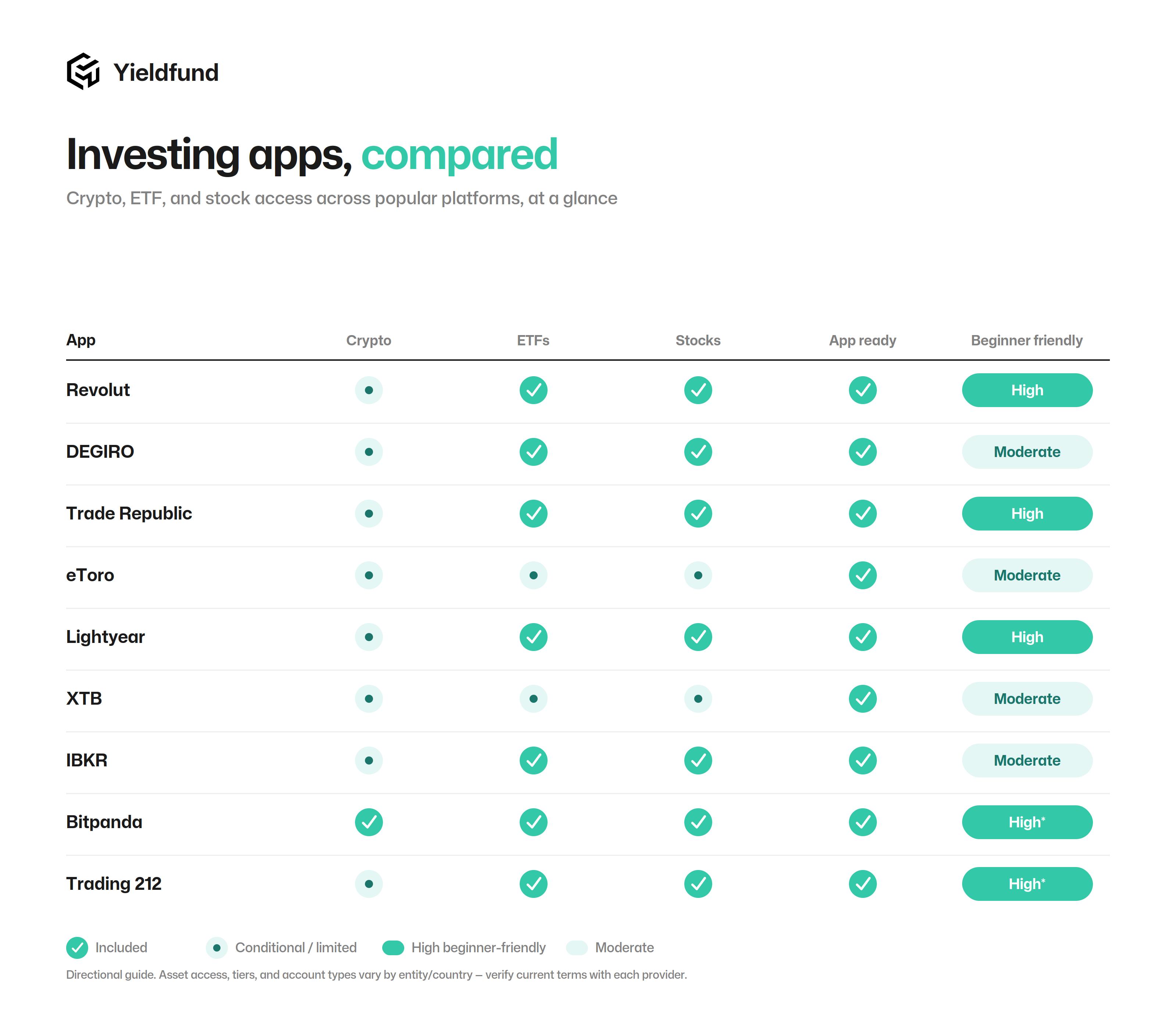
App comparison: crypto, ETFs, stocks and usability
“App ready” means a mobile app is available. Beginner-friendliness is our editorial assessment of ordinary investing, not a statement that every product suits beginners.
What does investing €100 a month actually cost?
A deposit minimum is the amount needed to fund an account. A trade minimum is the amount needed to buy a particular investment. Confusing the two can make an app look more accessible than it is.
Here is an overview of how much each app requires as a minimum investment.
How to choose the right investing app
Choosing your next investment tool means weighing your capital, goals, routine, and preferences. Now, most applications in 2026 have broad access to most investment features, so the decisions have to start with:
- Investing routine: Identify what you want to buy, how often, and how much control you want.
- Calculating costs: A €1 purchase charge equals 1% of a €100 order, but 0.1% of a €1,000 order. Add currency conversion and fund changes.
- Check the account: Confirm country eligibility, the legal provider, and the product you will own, since regulation doesn’t protect you from losses.
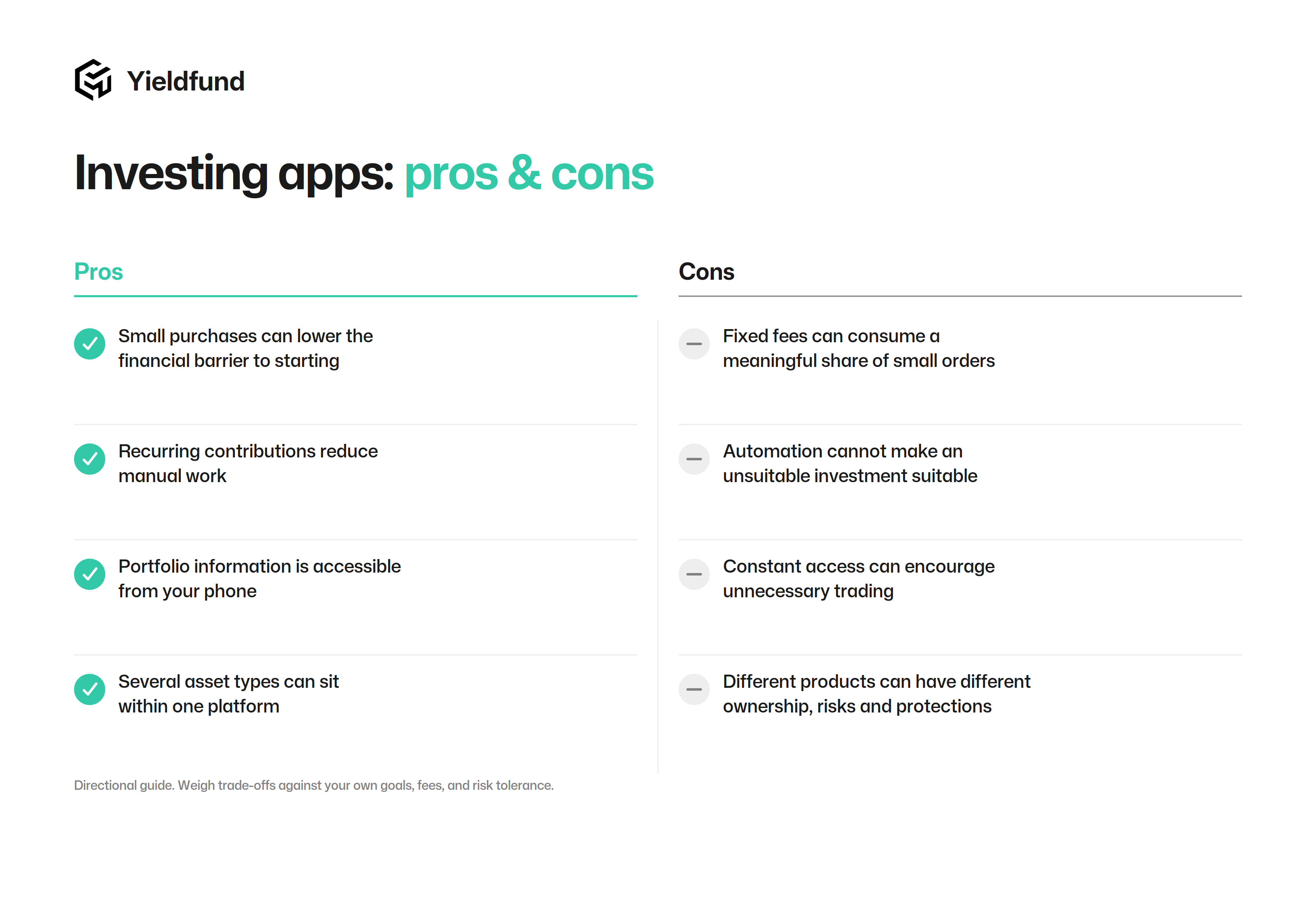
Pros and cons of investing through apps
What is the best investment app for beginners in Europe?
Trading 212 is our pick for beginners who want to build their own portfolio. Fractional purchases, Pies and scheduled contributions combine flexibility with low headline dealing costs. Start with an allocation you understand and check the minimum for your chosen Pie.
Revolut deserves consideration if you already use it, while Lightyear offers an approachable alternative in its supported countries.
The best beginner app is the one that fits your goals, and our suggestions are based on our observations and do not represent investment advice.
Before you choose an investment app
If you’re new to investing, search for an app by your country of residence, your initial amount, and how you want to invest. Those answers should guide you to the platform that matches your profile. Then analyze the fees and the UI before opening an account and signing up.
If you don’t want to manage investments by yourself, Yieldfund offers managed investment plans where you don’t have to make decisions or even trade. We trade the Top 10 cryptocurrencies by market cap, and based on your selected plan, you earn monthly yield that is paid out weekly.
If you are still working out a sustainable monthly amount, our guide to budgeting apps for 2026 can help you review your spending first.
FAQ
Are there any completely free investment apps?
Some services have no trading commission or account fee for specified activities. That does not remove an ETF’s own charges, spreads, possible currency conversion, or applicable taxes.
Can I start investing with €100?
Yes, you can invest with any amount as long as you cover any fees. Always check the instrument’s minimum and the amount left after fees, as a low account-opening minimum doesn't guarantee every investment is affordable.
This is not invesment advice and always do your own research before taking any decisions.
About the authors

Written by
Vlad Hategan
SEO content writer
Writes the articles in the Yieldfund knowledge base.
Dutch, English, Romanian

Translated by
Patricia Van den Kerckhove
Senior content translator
Translates and reviews Yieldfund's content in Dutch.
Dutch (NL & BE), French, English