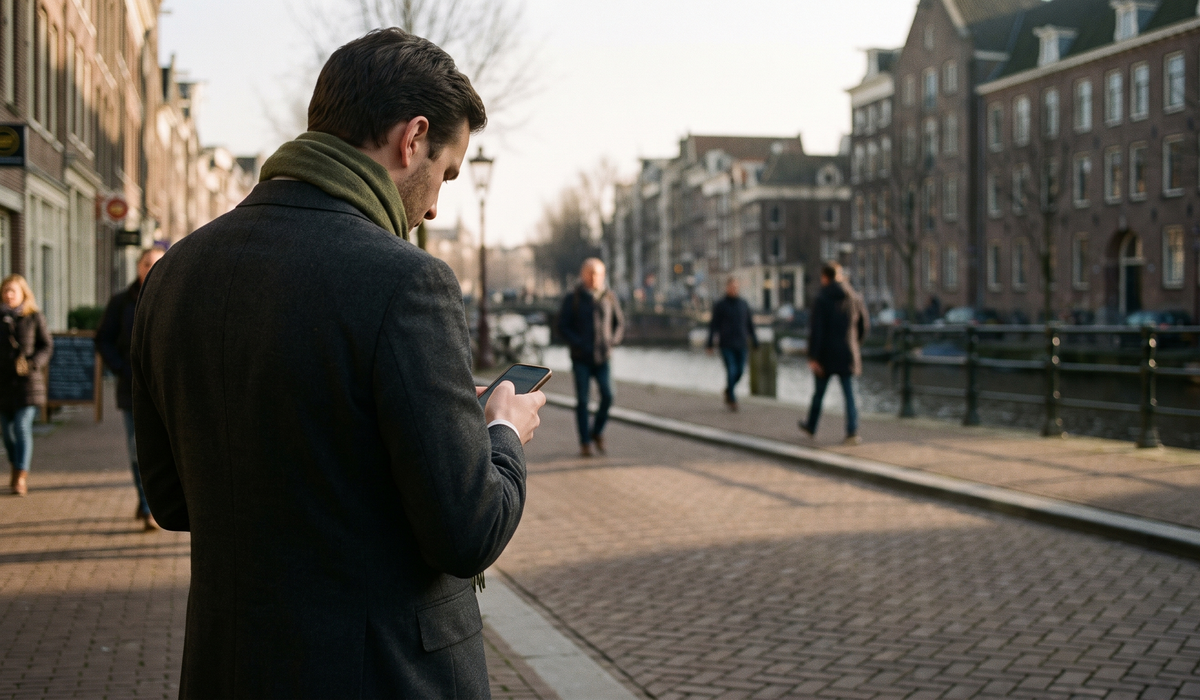

- Mobile banking is widely adopted in the Netherlands by over 65% of the population.
- Traditional banks are adapting to digital needs by making mobile apps easier to use to compete with neobanks.
- What the best app is depends on the situation and the context you want to use the application for.
- Mobile banking app security has advanced significantly, with biometric logins, real-time fraud alerts, and high encryption standards now commonplace.
The Netherlands is one of Europe's most cashless societies, making mobile banking apps an essential part of daily life. Without a bank, it is nearly impossible to live in the country since all amenities and day-to-day living are linked through your bank.
As the landscape becomes more competitive year by year, mobile banking is highly important since local branches have shut, hence the article's necessity. With each bank having its own strong features, this article is here to break it all down.
Mobile banking apps in the Netherlands
Mobile banking apps have become central to the Netherlands' position as one of the EU's most digitally advanced banking environments. Adoption rates rank among the highest in the EU/EEA region, with 65% of the Dutch population using mobile banking apps and over 80% connected to the broader banking system.
Banking apps now handle most transactions, and the adoption curve reflects a shift that has been building for over a decade. Most Dutch banks offer full-featured mobile apps alongside their traditional branch networks. As physical branches close, financial institutions are building their apps to meet customer needs.
For anyone managing a budget, tracking recurring payments, or keeping tabs on day-to-day expenses, the level of mobile maturity means faster access to your own financial data.
Top mobile banking apps in the Netherlands in 2026
The market for banking applications is getting more crowded in the Netherlands. As financial institutions start to compete with neobanks, the Netherlands has a mix of mobile banking applications, and we're comparing the fundamentals.
Below we're describing the features of each bank, how they operate, what their strong suits are, and how each fits into the Dutch mobile banking app market.
ING
ING is one of the largest banks in the Netherlands and provides a full suite of financial services through its app, including bank accounts, savings products, loans, investments, and insurance, along with built-in comparison and calculation tools. Its Go package costs €4.00 per month and comes with a Dutch IBAN, for investors who want one app that handles both day-to-day spending and a window into savings or investment products.
Rabobank
Rabobank is one of the Netherlands' established high-street banks, offering the kind of combined branch-and-app banking experience common among the country's largest providers. Fees and payments depend on the type of contract someone has with Rabobank; however, the bank is a preferred platform because many Dutch employers default to Rabobank for payroll-linked banking relationships.
ABN AMRO
ABN AMRO is another of the Netherlands' major banks and is notably the creator of Tikkie, the popular payment-request app that customers of any Dutch bank can use to split bills. ABN AMRO's own Basic Payment Package costs €4.30 per month and includes a Dutch IBAN. Opening an account typically requires a branch appointment rather than a fully remote process, which is worth factoring in if speed is a priority.
Bunq
Bunq is a Dutch-built neobank, and one of the first neobanks to operate in the Netherlands. It is built around Money Pockets, which are sub-accounts, each with its own IBAN. Within 10 minutes, anyone can open an account, and users can split their money across categories like rent, groceries, travel, etc. The Free plan includes 3 Money Pockets, Core includes 5, and the Pro and Elite tiers include 25 each. What's impressive for Bunq is that new customers can open an account before submitting a BSN, with a 90-day window to provide it. As a neobank, Bunq is rapidly expanding into more features such as investing, crypto, or Pockets for money organizing.
Revolut
Revolut has launched a dedicated Dutch branch, and customers resident in the Netherlands are being migrated to this branch and issued a Dutch IBAN. Plan details are the same as in most EU countries, with a free plan available and Premium, Metal, and Ultra offering better perks such as fees, app bundles, free ATM withdrawals, and fee-free investments. Revolut's broader appeal lies in holding balances across multiple currencies, including crypto, which resonates with users who hold capital across global markets.
Knab
Knab is a fully online Dutch bank, founded in 2012 and formerly part of Aegon Bank before being acquired by the Austrian BAWAG Group. As a Dutch-licensed digital bank, it issues a Dutch IBAN and operates without a branch network, positioning it between traditional banks and app-only neobanks.
N26
N26 offers a straightforward, expat-friendly onboarding experience, but accounts opened in the Netherlands typically come with a German IBAN rather than a Dutch one. Some Dutch employers, landlords, or service providers may specifically request an NL IBAN, so it's worth confirming with your employer or counterpart before making N26 your primary account. However, N26 never requires a BSN during registration, and its shared-expense overview tools make it a solid choice for joint account holders.
Why are mobile banking apps used more frequently?
In 2025, smartphones and smartwatches accounted for 39% of all point-of-sale payments in the Netherlands, up from 34% in 2024.
Convenience has become the baseline expectation, not a bonus feature, so mobile apps remove friction for normal financial tasks. Approximately 25% of debit-card transactions were already being made via smartphone or wearable by 2022, according to Betaalvereniging Nederland, with contactless payments making up the vast majority of monthly debit transactions.
The main reason banking apps are more popular is how convenient they are to use. Finances are an important pillar that everyone needs to get a hold of, and letting users contact bank staff through social channels, access funds while traveling abroad, and check balances around the clock, without visiting a branch, brings more business.
For a generation raised on instant digital services, that level of access has made traditional branch-only banking feel increasingly outdated.
What features set the best banking apps apart?
Banking apps might seem like a one-size-fits-all, but each bank wants to stand out with unique features. Apart from sending, receiving, checking balances, and recurring payments, other features make banking apps stand out:
- Instant payments and transfers: Move money between accounts or to friends in real time.
- Budgeting tools: Secondary accounts that allow users to separate their funds for different occasions or to help with creating a budget.
- Multi-currency support: Useful for anyone receiving income or making payments in currencies other than euros.
- 24/7 account access: Check balances, review transactions, and manage settings at any hour.
- In-app customer support: Many neobanks offer multilingual chat support directly within the app.
- Biometric security: Fingerprint and facial recognition logins add a layer of protection beyond passwords.
- Investing and trading: Banking applications that also act as a broker create an all-in-one financial experience.
For anyone who treats cash flow management as a precursor to longer-term capital allocation, these features matter beyond convenience. A banking app with strong budgeting tools and real-time visibility makes it easier to identify how much capital is available.
Difference between mobile banking apps and neobanks
A mobile banking app is the digital interface through which you access your bank account, which still has a physical network in the country. A neobank, by contrast, is a bank or a banking entity that operates primarily or entirely through that app, without a traditional branch network.
ING, Rabobank, and ABN AMRO are traditional banks with full mobile apps layered on top of branch-based service. Bunq, Revolut, and N26 are neobanks, built app-first from the ground up. Knab sits somewhere in between: it's a licensed Dutch bank, but one that operates entirely online without physical branches.
Between 2013 and 2025, the number of physical bank branches in the Netherlands declined by 71%
Are all banks in the Netherlands digital banks?
No, we can't say that every bank is a digital bank since traditional players like ING, Rabobank, or ABN AMRO (as the biggest ones) have branch networks and in-person advisory services, which matters for anyone who wants face-to-face support for mortgages, investments, or complex financial planning.
Neobanks like bunq, Revolut, and N26 are app-first by design, with customer service handled primarily through chat or email. What's important to note is how the banks operate in the background, but this will be covered in a separate article.
Which mobile banking app is the best?
We can't recommend or say that one bank is better than another. It all comes down to personal preferences, how you handle your finances, and what you need from your bank.
- Best for traveling: Revolut. Revolut's multi-currency capabilities, now backed by a Dutch branch and local IBAN, make it an ideal choice for frequent travelers looking to manage multiple currencies in one account.
- Best for couples: ING. With its all-in-one approach to accounts, savings, and investment tracking, ING gives couples and families a single, Dutch-IBAN platform to manage shared finances and long-term goals together.
- Best for employees: Rabobank. Rabobank provides the kind of full-service, salary-friendly banking that most traditionally employed residents expect.
- Best for freelancers: Bunq. The Money Pockets structure makes it easy to separate business income, tax savings, and personal spending into distinct sub-accounts, each with its own IBAN.
How security for mobile banking has evolved
Mobile banking security has moved through several distinct phases. Early online banking relied on static passwords and physical card readers generating one-time codes. As mobile apps matured, banks shifted toward app-based confirmation, where transactions require approval directly within the banking app rather than a separate device.
Today, biometric authentication, including fingerprint and facial recognition, has become standard across most major apps, offering stronger protection than PINs or signatures alone. Real-time transaction alerts now notify users instantly of account activity, making it easier to catch fraud early. Dutch banks also participate in shared fraud-prevention protocols, collaborating on information sharing to flag suspicious activity across institutions.
Encryption standards have also strengthened considerably, and the payments industry has been preparing for emerging risks, including quantum-resistant security measures, as part of its long-term infrastructure planning.
Practical steps to protect yourself include:
- Enabling biometric login wherever the app supports it.
- Never sharing one-time codes or passwords, even with someone claiming to be from your bank.
- Avoiding public or shared Wi-Fi when logging into your banking app.
- Checking that your deposit guarantee applies: eligible deposits in Dutch-licensed banks are generally protected up to €100,000 per person, per bank under EU-wide deposit guarantee rules.
Where to start when choosing a mobile banking app in the Netherlands
Start by understanding what a necessity is, and that is to have a local IBAN account. That makes it possible to become integrated into the financial system and use the bank to pay for rent, cover utilities, pay taxes, get a tax refund, and use incasso.
The second thing to consider is how much you value speed or how much you trust new financial products. If you want a traditional experience where you can schedule face-to-face meetings or even talk with someone in person, then banks like ING, ABN AMRO and Rabobank still have the service - although it might not be for long.
Alternatively, Bunq or Revolut offer a fully digital experience, with better upside in terms of other features, such as investing, crypto or digital loans.
Once you've identified your needs and matched them to what each bank offers, it's time to evaluate the costs. Fees, supported languages, and app features (including security) have to be compared before opening an account.
Regular banks have plans that require a monthly contribution, while neobanks such as Revolut or Bunq allow for free banking, but with some limitations. If you want more features, it's only normal that you'll have to pay for it.
FAQ
Do I need a Dutch IBAN for everyday banking?
Yes, in the Netherlands, a Dutch IBAN is required to receive salary deposits, pay rent, cover utilities, and even pay government taxes. The upside is that you don't need a Dutch IBAN to use Tikkie.
Can I open a Dutch bank account before moving to the Netherlands?
Yes, you can open a Dutch bank account, but in most cases, ING and other banks require customers to undergo KYC and provide a valid BSN or residence permit within 90 days of opening an account.
Which app is best for freelancers?
Bunq and even Revolut are strong options for freelancers because they can be used from anywhere, and their sub-account features make it easy to separate business income for taxes from personal expenses.
About the authors

Written by
Vlad Hategan
SEO content writer
Writes the articles in the Yieldfund knowledge base.
Dutch, English, Romanian
Translated by
Vlad Hategan
SEO content writer
Writes the articles in the Yieldfund knowledge base.
Dutch, English, Romanian