
DCA in crypto is a way to invest without timing the market and to simplify the entire process. For investors, the idea of selecting the right time to buy creates a strong dilemma, and DCA is a more structured approach with fixed investment amounts.
In this guide, we explain what DCA in crypto is, how it works, and the advantages of this strategy.
What is DCA in Crypto?
DCA, or dollar-cost averaging, is a way to invest in cryptocurrencies over a long period, regardless of market volatility. The strategy means that a person invests a fixed amount of money in a crypto asset at regular intervals - for example, on the 1st of the month. So instead of allocating a larger sum of money all at once, the person spreads the same investment over time.
A simple example is investing $500 in Bitcoin on the 1st of the month, then buying the same face value amount each month for a year.
What does DCA stand for in crypto?
Dollar-cost averaging, or DCA in crypto, is an investment schedule: equal amounts are invested at regular time intervals without shifting the plan in response to short-term market prices. Because the cash amount stays fixed, the investor receives more units at lower prices and fewer units at higher prices.
How to use DCA in crypto
To use DCA in crypto as a well-thought-out strategy, a person needs to define their goals, their investment period, their allocation, and a recurring plan. Then the process is straightforward, requires commitment, and includes automation to avoid having to manually purchase or forget to make purchases. Here is a straightforward plan to do so:
- Investors need to determine how much they want to allocate each month and their total allocation.
- Then they need to look at how they want to invest. Some people prefer to invest every month, while others prefer a bi-monthly allocation. Other options include weekly or even daily expenses, depending on preference.
- Use crypto investment platforms or crypto exchanges to automate recurring purchases. This removes the need to execute trades manually and maintains the plan stable.
- Regularly review the investment process to avoid overspending and to understand how your portfolio has grown.
How to DCA Ethereum (ETH)
To DCA in Ethereum, invest the same amount of money by purchasing ETH tokens at regular intervals, regardless of its current market price. For example, an investor could purchase €100 of ETH on the first day of every month instead of investing €1,200 at once.
Buying tokens at different times means DCAing in ETH when price is low but also when the price is higher. As explained in our above example, when its price is higher, it buys less but over time they develop an average purchase price based on all completed transactions
Here’s how DCAing in Ethereum looks like:
- Set up an ETH allocation
Begin by deciding the maximum amount to allocate to Ethereum. This should be based on the investor’s financial situation and tolerance for losses rather than a predicted ETH price.
Suppose an investor plans to allocate €1,200 over one year. The amount could be divided into 12 monthly purchases of €100 and establishing the total limit in advance reduces the risk of increasing the investment impulsively.
- Choose a purchase schedule
An Ethereum DCA strategy can use daily, weekly, biweekly or monthly purchases. There is no schedule that consistently produces the best return in every market.
The selected interval should be easy to maintain and appropriate for the size of each investment. Very frequent purchases may create more trading fees and records, while less frequent purchases provide fewer entry points.
- Select where to buy ETH
ETH can be purchased through a centralized exchange, brokerage service or decentralized exchange. Each method has different costs and risks. Before investing, compare fees, payment charges, minimum purchase amounts, ETH withdrawal fees and platform avalability.
- Automate the recurring purchase
If the selected platform supports recurring orders, the investor can choose the amount, frequency and payment method. Automation helps maintain the schedule without requiring a manual decision before every purchase.
- Decide on where to store tokens
ETH purchased through a platform can generally be left in a custodial account or transferred to a self-custody wallet.
Custodial storage is simpler, but it exposes the investor to risks involving the platform, including account restrictions, security incidents or insolvency. Self-custody gives the investor control of the assets but also makes them responsible for safeguarding private keys and recovery information.
What is the best DCA strategy for crypto?
The best crypto DCA strategy is one that uses an affordable fixed amount, follows a consistent schedule and can continue through both rising and falling markets. There is no single investment amount or purchase frequency that works for everyone.
The plan should reflect the investor’s income, financial goals, time horizon and tolerance for losses, however it should follow the same structure: buying more units when the price is lower and fewer when it is higher.
Here’s how you get the best out of the strategy:
Start by determining how much money can be invested without affecting essential expenses, emergency savings or short-term financial commitments. A DCA allocation should not be increased simply because a cryptocurrency is rising or because of fear of missing out.
Select the purchasing frequency of weekly, biweekly or monthly purchases and they should fit when investors receive their payments/salaries. Worth noting is that frequent purchases spread entry points but can create additional fees and transaction records. Less frequent purchases are simpler to manage but provide fewer entry points.
The best DCA strategy for crypto is when you first research the crypto market. DCA changes how an asset is purchased; it does not make a weak asset a good investment. Always consider factors such as:
- The asset’s purpose and adoption
- Network activity and development
- Liquidity and market capitalization
- Token supply and issuance
- Security and custody risks
- Regulatory uncertainty
- The investor’s existing portfolio exposure
Setting limits to your plan is how you stay on top of the expenses. A DCA strategy should have a defined budget, duration and review schedule. For example, an investor might commit to investing €100 monthly for one year and review the plan every three months.
Example of a simple crypto DCA strategy
Suppose an investor decides to allocate €1,200 to Ethereum over one year. The plan could be structured as follows:
- Asset: Ethereum
- Amount: €100 per purchase
- Frequency: Once per month
- Duration: 12 months
- Maximum allocation: €1,200
- Review frequency: Every three months
- Purchase method: Automated recurring order
- Risk rule: Do not use leverage or money needed for essential expenses
How is DCA calculated in crypto?
DCAing is calculated by dividing the total investment amount by the total number of Bitcoin or Ethereum you currently hold.
| Purchase | Amount invested | Asset price | Units received |
|---|---|---|---|
| 1 | €100 | €50 | 2.00 |
| 2 | €100 | €25 | 4.00 |
| 3 | €100 | €100 | 1.00 |
| Total | €300 | – | 7.00 |
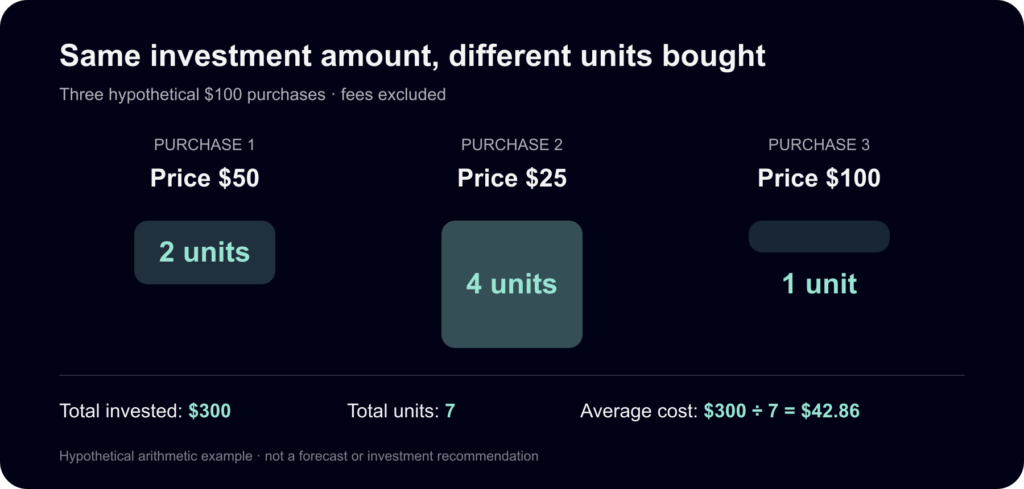
In our above example we purchased 7 units with an average buy price of €42.86 per unit. Do not simply average the three market prices: (50 + 25 + 100) ÷ 3 = €58.33 as that ignores that the fixed investment bought different quantities at each price.
Thus, the fixed amount bought four units at $25 but only one unit at $100. DCA changes purchase quantity automatically; it does not guarantee that the final market price will be above the average cost.
Is DCA an effective strategy?
Dollar-cost averaging DCA can reduce the regret of committing all available cash immediately before a decline and can help investors follow a repeatable plan. Its trade-off is that some money remains uninvested while the schedule is being completed.
When the price of an asset rises during that period, investing the available lump sum earlier can produce a higher ending value. The right comparison depends on whether the investor already has a lump sum or is investing new income as it arrives; these are different decisions.
Advantages of Dollar-Cost Averaging
- Reduces the impact of market volatility: By spreading investments over time, you avoid the risk of putting all your eggs in the market just before a downturn.
- Eliminates the need to time the market: You don't need to predict whether prices will rise or fall. You simply invest consistently, regardless of market conditions.
- Encourages disciplined investing: Automation removes emotional decision-making and helps you stay committed to your investment plan.
- Low barrier to entry: You don't need a large lump sum to start investing. DCA makes crypto accessible with smaller, regular contributions.
Drawbacks of Dollar-Cost Averaging
- Potential for lower returns in a bull market: If prices consistently rise, a lump-sum investment at the beginning would have generated better returns than spreading purchases over time.
- Requires patience and discipline: DCA is a long-term strategy. You need to maintain consistency even during market downturns.
- Not suitable for short-term investors: If you're looking for quick profits, DCA's gradual approach may not align with your goals.
Build your crypto portfolio with confidence
Dollar-cost averaging offers a disciplined approach to crypto investing that reduces stress and helps manage volatility. By investing fixed amounts at regular intervals, you remove the guesswork from timing the market and build your portfolio gradually.
If you want exposure to the crypto market without the hassle of managing DCA purchases yourself, Yieldfund offers three investment plans with up to 60% annual interest. As a quantitative trading company, we handle the complexity of trading while you enjoy returns and weekly payouts.
FAQ
How often should I DCA in crypto?
Following a DCA strategy in crypto depends on the capital available, but we believe monthly investments perform better than weekly DCAing.
What crypto is good for DCA?
Based on our experience, DCA does not turn every token into a suitable long-term holding. Before setting a recurring purchase, assess liquidity, trading-venue availability, custody, concentration, technical and regulatory risks, and whether you can afford a complete loss.
About the authors

Written by
Vlad Hategan
SEO content writer
Writes the articles in the Yieldfund knowledge base.
Dutch, English, Romanian

Translated by
Patricia Van den Kerckhove
Senior content translator
Translates and reviews Yieldfund's content in Dutch.
Dutch (NL & BE), French, English