
- The best crypto exchanges in the Netherlands are Coinbase, ByBit, OKX, Kraken, and Coinmerce.
- Crypto exchanges fall under Crypto Asset Service Providers and are required to hold a MiCA license in the EU.
- Bitvavo and Coinmerce are the only Dutch-founded cryptocurrency exchanges from our list.
- Crypto exchanges can be centralized and decentralized, with decentralized ones being less regulated in the Netherlands.
The best crypto exchanges in the Netherlands are MiCA-regulated, have strict security measures , and let users buy and sell cryptocurrencies using iDEAL, debit cards and Dutch-accepted payment methods.
Since July 2026, every crypto platform must follow EU regulations. Since not every crypto company complies with the new regulation, we’re explaining exactly which crypto exchanges can operate in the Netherlands.
Comparison of the best crypto exchanges in the Netherlands
When you compare which platform to use to buy crypto in the Netherlands, what matters most is how easy they are to use, if they’re secure, how many tokens are available, and what their fees are. Here’s a breakdown
What is a crypto exchange in the Netherlands?
A cryptocurrency exchange in the Netherlands is a digital platform where traders and users can buy, sell, and trade cryptocurrencies such as Bitcoin or other altcoins. In the Netherlands, cryptocurrency exchanges are highly regulated under the MiCA licensing framework, which applies across the entire EU.
Cryptocurrency exchanges have evolved into complex ecosystems where users can acquire crypto assets and also store, stake, trade, use leverage, or leverage Web3 features to interact with the broader ecosystem.
All cryptocurrencies share the same features; some handle more assets, while others offer additional financial instruments for users to interact with the market. In the Netherlands and other EU countries, these platforms are highly focused on regulation and AML to meet minimum security standards and protect users' assets.
What are the types of crypto exchanges available in the Netherlands?
The MiCA license regulates and oversees how centralized exchanges (CEXs) operate, but across the region, other types of platforms are also operational, with different mechanisms for storing or using users' assets. The two main types of crypto exchanges in the Netherlands are Centralized and Decentralized Exchanges.
- Centralized Exchanges (CEX): The most common type. A company manages the platform, holds custody of your funds, and matches buyers and sellers. Examples include Coinbase, Kraken, and OKX. These offer high liquidity and user-friendly interfaces, but you don't control your private keys.
- Decentralized Exchanges (DEX): Operate without a central authority using smart contracts. You retain custody of your assets. However, DEXs typically have less liquidity, no fiat support, and limited regulatory oversight—making them more complex for everyday use.
For most Dutch investors, a regulated CEX is the most practical starting point. DEXs are better suited to advanced users who are comfortable managing their own wallets.
What is the difference between regulated and non-regulated crypto exchanges in the Netherlands?
As of December 30, 2024, the EU's MiCA regulation came into full effect across member states, including the Netherlands. All crypto service providers operating in the Netherlands must hold a CASP license; without one, they are operating outside the law.
The main difference is in the extent to which users' assets are safe and how they prevent money laundering. Decentralized Exchanges are unregulated. Users connect on-chain with their wallets, and KYC is minimal compared to a CEX.
Another difference is that CEXs must offer user fund protection and provide support if traders have questions, issues, or trouble accessing their accounts. On a DEX, the wallet secret phrase is what grants access to the account.
The Dutch Authority for the Financial Markets (AFM) supervises crypto-assets that qualify as financial instruments, while the DNB oversees service providers. If an exchange isn't listed in either registry, view it with caution, as it may carry risks.
Crypto Asset Service Providers are required to hold a MiCA license in the Netherlands since July 1st 2026
How to select the best crypto exchanges in the Netherlands
For Dutch users, the best exchange is the one that meets their needs. If you’re an active trader, the best exchange is one that offers lower fees as your volume increases. For example, OKX, Kraken, and Coinbase offer tiered fee levels where fees decrease as volume increases.
If you want to buy and hold, choose the exchange with strong security. If you’re a Web3 native, then you can use a DEX and store crypto in your own wallet. If not, you can choose an exchange that offers staking so you can earn while holding your assets.
The type of trading matters also. Futures markets aren’t fully available on every platform. If you want higher leverage, choose exchanges that let you take on more risk. Always remember that trading carries risks and can lead to complete losses.
Finally, if you want a wider range of assets, choose exchanges that list new ones more often. For example, Kraken has over 600 different crypto assets.
Before selecting an exchange, understand your needs, then review the exchange's features. Below, we have a review of some of the popular exchanges that are available in the Netherlands.
Best crypto exchanges in the Netherlands
Coinbase
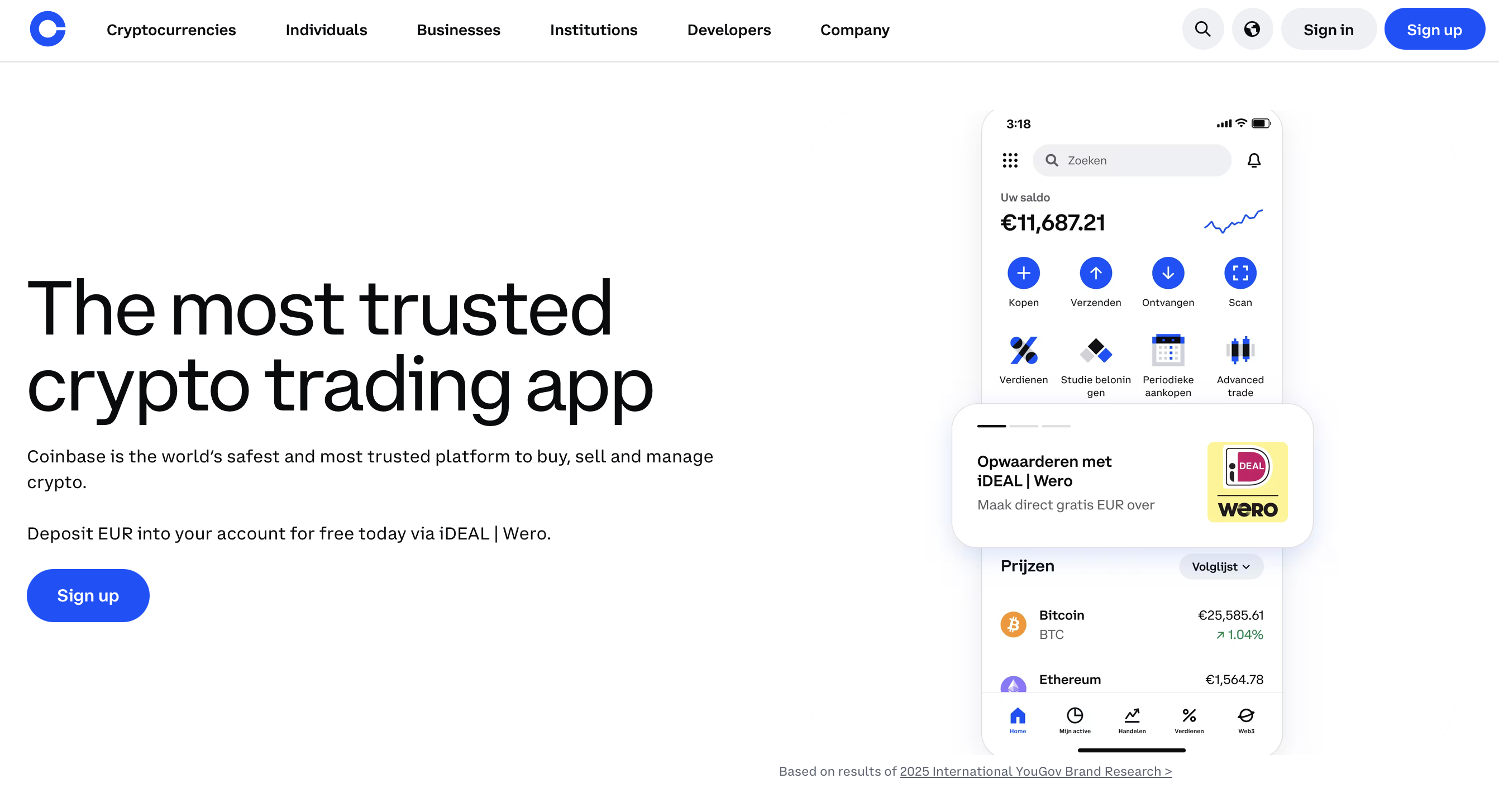
Coinbase is one of the most widely recognized crypto exchanges globally, with over 100 million users across 30+ countries. It has a MiCA license, so it is fully regulated, with 0.25% and 0.50% maker/taker fees. The platform is good for new users because of its clean, easy-to-understand interface and a strong educational section.
Traders can access both spot and futures markets, with futures available only to Advanced traders, and fees follow a tiered structure that decreases with higher trading volume. Coinbase has some shortcomings, such as longer-than-normal withdrawal wait times compared to other exchanges.
Key features:
- Holds multiple regulatory licenses
- 409 cryptocurrencies globally
- Assets stored in cold wallets
- 0.25%–0.50% marker/taker fees (lower on Coinbase Advanced)
Coinmerce
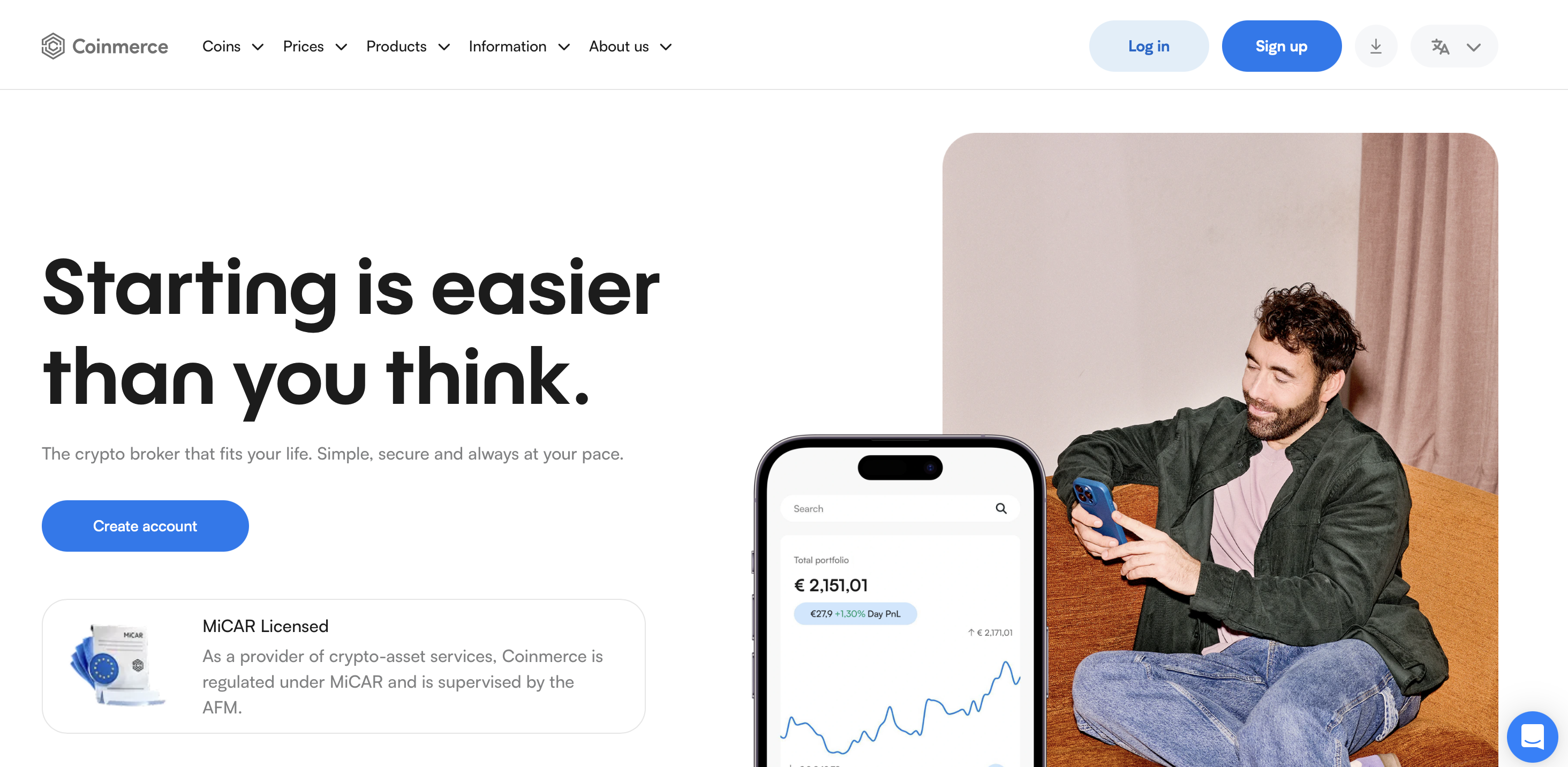
Coinmerce is a Netherlands-native crypto exchange, founded and headquartered there. It is now MiCA-authorized in the Netherlands and offers a wide range of crypto assets. Fees are 0.25%, and as a Dutch entity, Coinmerce offers over 300 crypto assets. Dutch traders can’t access futures markets on Coinmerce. However, for Dutch investors who prioritize local compliance, EUR simplicity, and a native Dutch platform experience, Coinmerce is a practical and trustworthy choice.
Key features:
- Licensed as a CASP provider in the Netherlands
- EUR deposits supported via iDEAL
- Intuitive, beginner-friendly interface
- No futures markets
OKX
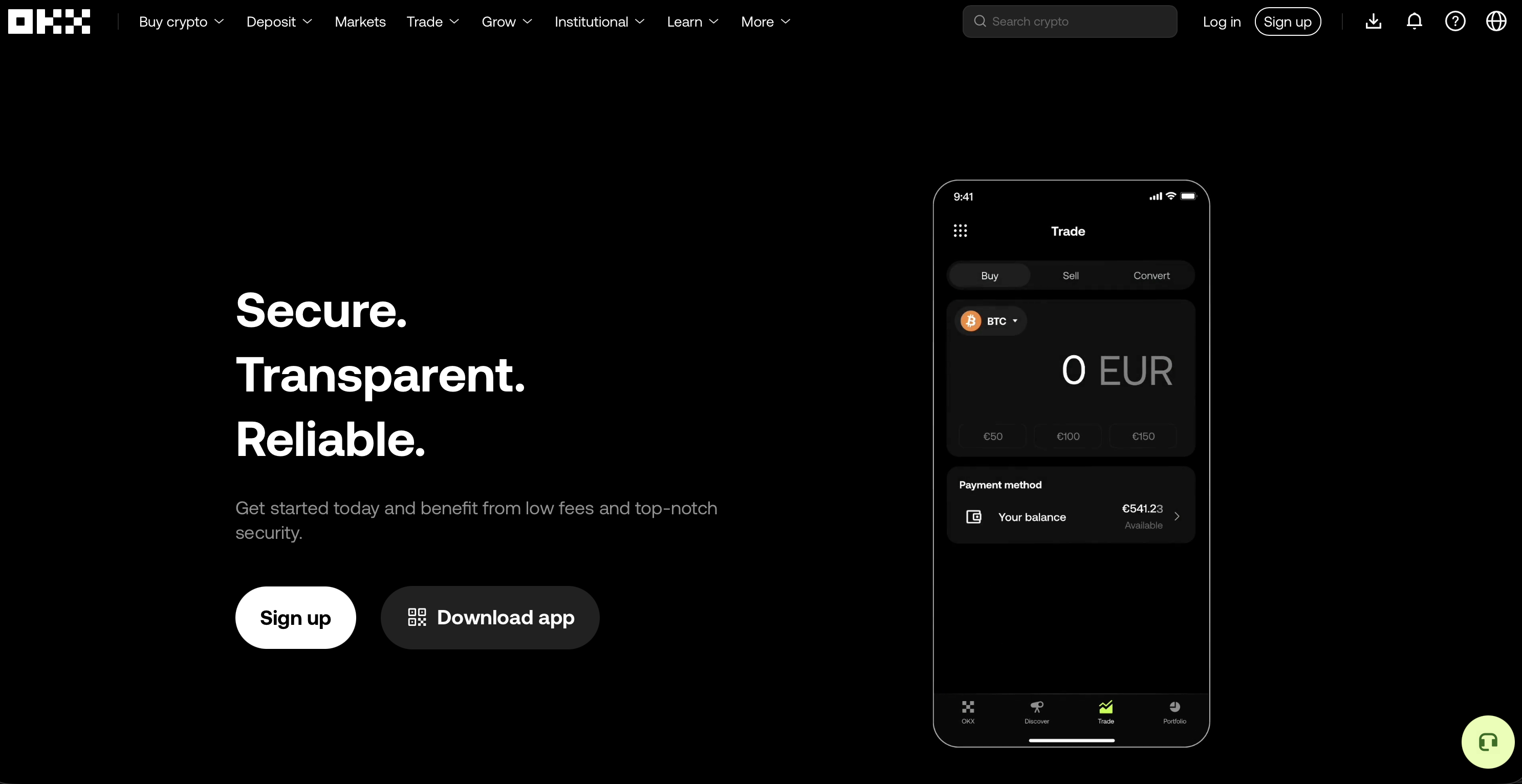
OKX officially launched as a licensed crypto service provider in the Netherlands on June 3, 2024, making it one of the newer entries in the Dutch market. OKX is a well-established global exchange with over 300+ crypto assets. It offers both spot and futures markets across the Netherlands and Europe, making the platform versatile.
OKX has a hybrid CEX/DEX system that appeals to intermediate and experienced users. Users can trade securely in institutional settings while still accessing DeFi features from the same interface. For Dutch traders, the combination of local payment support and a broad asset list makes it one of the more complete newer options on the market.
Key features:
- 302 crypto assets for spot and derivatives trading
- Fees: 0.10% maker/ 0.20% taker
- Self-custody wallet included
- Supports both CEX and DEX trading
Kraken
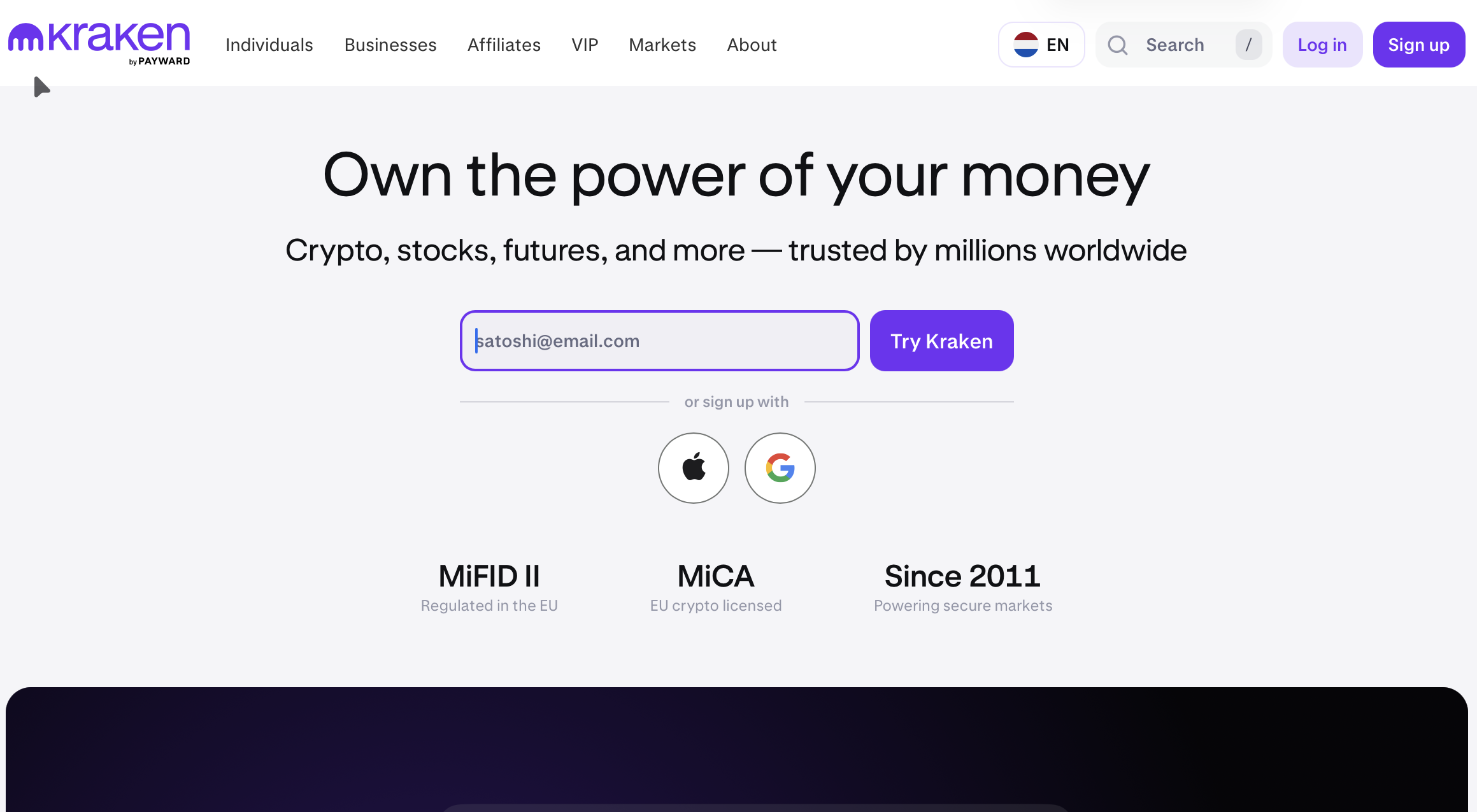
Kraken is one of the longest-running crypto exchanges in the world. The platform is easy for inexperienced users to understand and supports multiple EUR deposits, including iDEL and SEPA in the Netherlands. It offers 600+ tradable cryptocurrencies and high trading volumes, making markets highly liquid.
Kraken suits both private and institutional users but charges high spot trading fees of 1%, with maker-taker fees of 0.40%/0.80 %, among the highest in the industry. Futures markets are available in the Netherlands but are subject to eligibility.
Key features:
- 600+ cryptocurrencies supported
- iDEAL deposits available for Dutch users
- Higher maker and taker fees
- Highly rated for security and regulatory compliance
Bitvavo
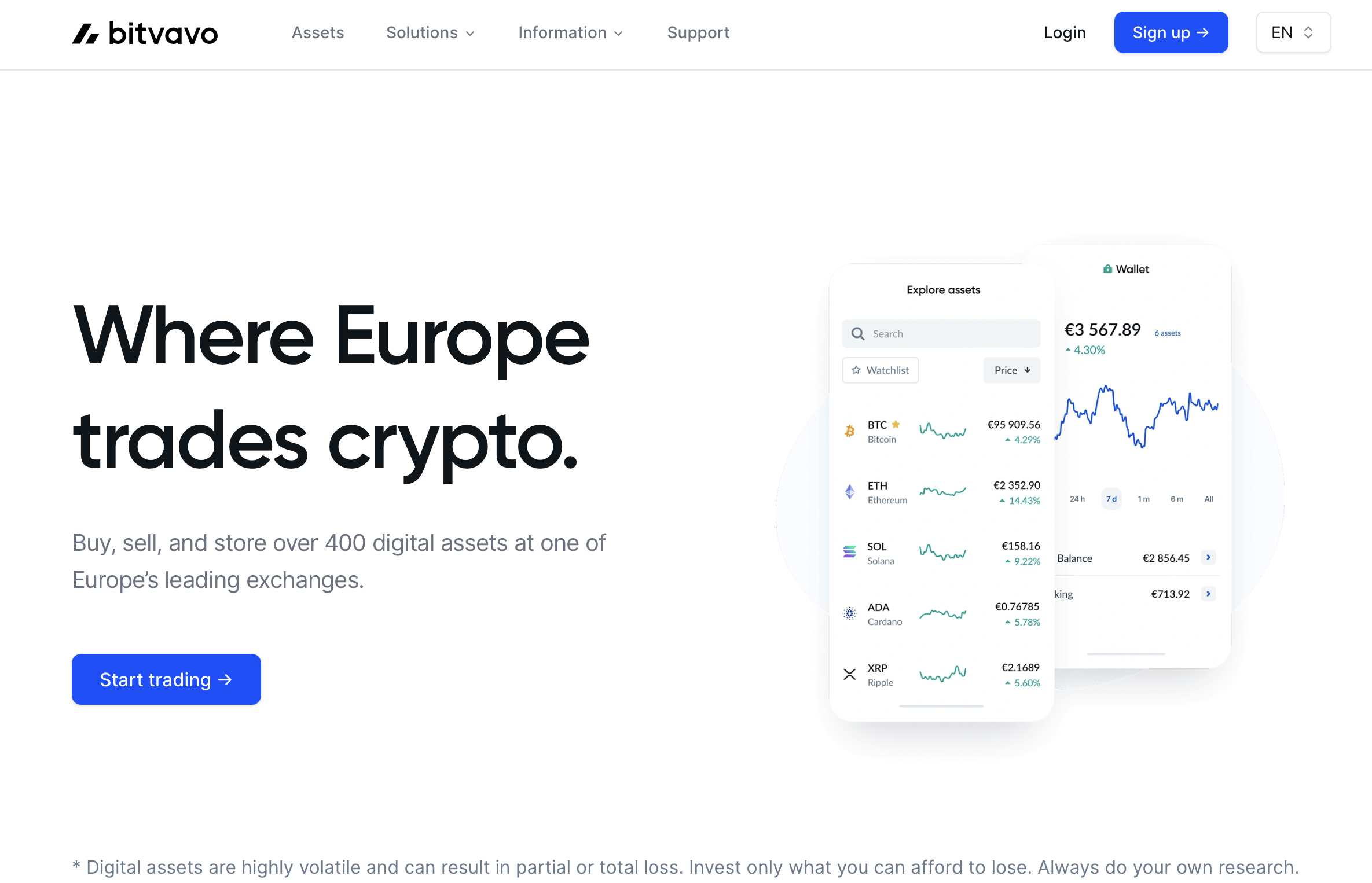
Bitvavo is a Dutch crypto exchange that launched in 2018 and is headquartered in Amsterdam. It supports over 400 tokens and offers only spot trading. Even with a MiCA license, Bitvavo doesn’t provide any adjacent instruments such as futures markets.
Daily volumes range in the $200 million range, and Dutch traders pay spot access fees of 0.15% / 0.25% for makers and takers. Deposits are easy with iDEAL or other SEPA-compatible payments like debit or credit cards, and the platform's intuitive design makes it easy to navigate.
Key features:
- Dutch-based crypto exchange
- Supports iDEAL and SEPA payments
- Friendly design with no light version
- No futures trading
Bybit (Bybit.eu)
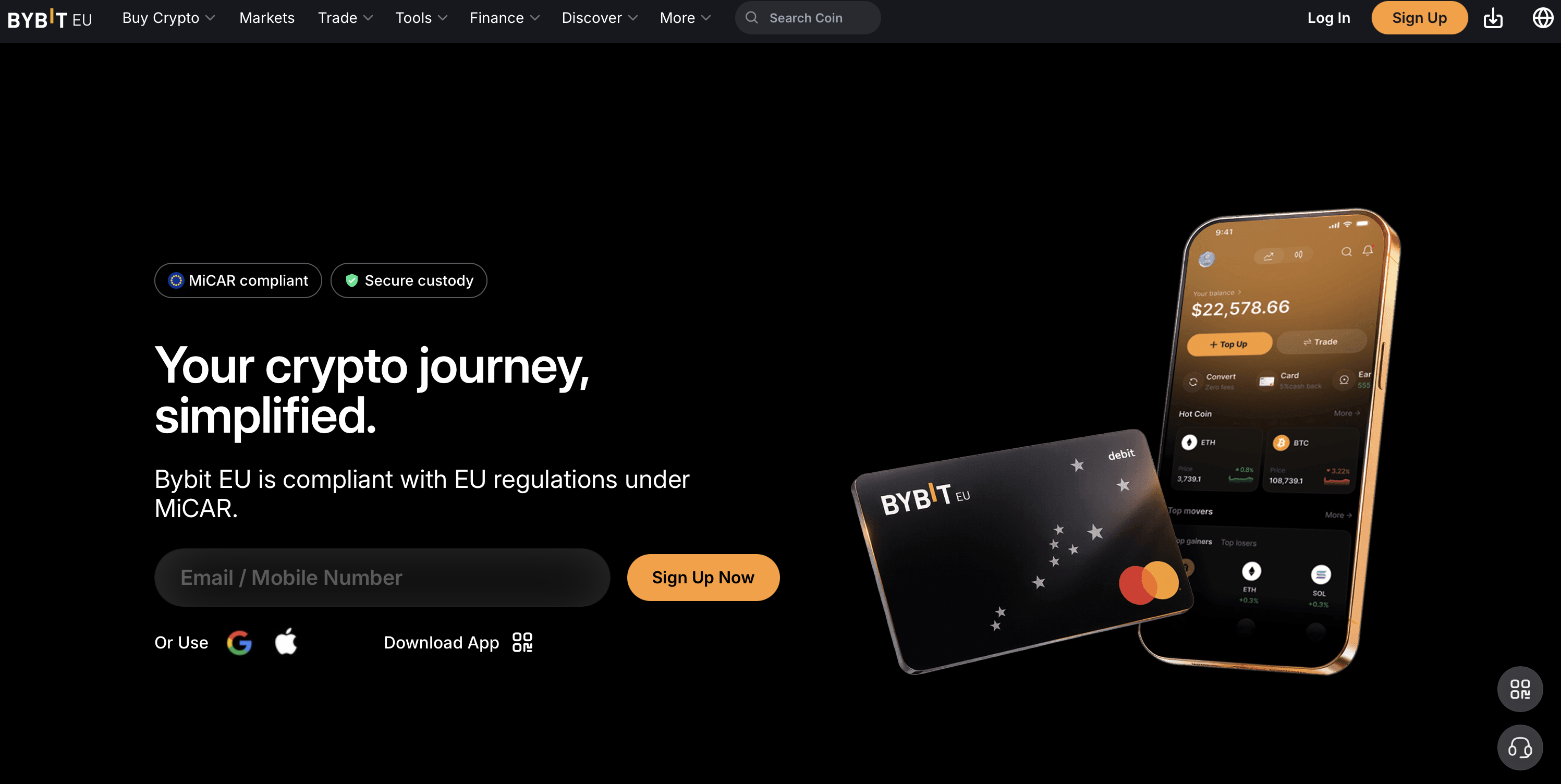
Bybit is a regulated crypto exchange with an EU branch. The EU platform is MiCA-registered and supports only spot markets, unlike its global site, where traders can access futures markets. ByBit EU suits both intermediate and experienced traders, with fees starting at 0.25% for makers and takers. Users can deposit via iDEAL and SEPA, and new users can use ByBit's light version for quicker navigation.
Key features:
- 106+ supported cryptocurrencies
- Spot maker and taker fees of 0.25%
- €10 minimum deposit for fiat transactions. Crypto deposits vary per token.
- EUR and SEPA deposit support
Which crypto trading apps are best for Dutch users
The best crypto trading apps for Dutch users depend on how much control you want over your account and how easy the interface is to navigate. Based on our experience using these apps, here’s how each one stands out.
What payment methods can you use on Dutch crypto exchanges?
Dutch residents have several funding options available across major platforms:
- SEPA bank transfers: The most cost-effective method for EUR deposits. Widely supported by all MiCA-licensed exchanges.
- iDEAL: A popular Dutch instant bank payment system accepted by Coinmerce, Kraken, Bitvavo, and Bitonic
- Credit and debit cards: Available on most platforms, but typically carry higher fees than bank transfers. Useful for quick, smaller purchases.
- PayPal: Supported by Coinbase for deposits and withdrawals.
- Crypto deposits: Transfer existing crypto holdings from a personal wallet or another exchange—usually the cheapest withdrawal method.
What are the alternatives to crypto exchanges for Dutch traders?
Alternatives to trading crypto outside crypto exchanges in the Netherlands are limited, but for some crypto operations, traders can look at ATMs, brokers, or P2P platforms.
- Bitcoin ATMs: As of 2023, approximately 20 Bitcoin ATMs operate across the Netherlands, allowing cash purchases with minimal verification for small amounts.
- Crypto brokers: Financial brokers and neo-banks have all added crypto to their portfolio. eToro, Revolut, and Bunq (Native in the Netherlands) all offer access to crypto trading, with some limitations, such as no derivatives trading.
- P2P platforms: Peer-to-peer trading lets buyers and sellers transact directly. MEXC and WhiteBIT both offer P2P functionality with EUR support.
- Crypto ETFs: ETFs now provide access to direct Bitcoin and Ethereum exposure within a traditional brokerage account.
The move into crypto
The Dutch crypto market is one of the most structured in Europe, thanks to MiCA and DNB oversight, which means crypto exchanges in the Netherlands are more regulated. That's genuinely good news for any type of investor since platforms have cleared compliance and are "safer" to use.
For beginners, Coinbase, Bitvavo, or Coinmerce offer the simplest onboarding in the Netherlands, while experienced traders who want a more complete way to trade crypto can use OKX or Kraken from our list.
If you want a different way to access the crypto market, without having to worry about trading, liquidity, and storage, Yieldfund is a quant-trading company where investors don’t trade themselves and access crypto yields based on a fixed plan.
Frequently Asked Questions
Is crypto trading legal in the Netherlands?
Yes, crypto trading is legal in the Netherlands. As of December 30, 2024, all crypto service providers must comply with the EU's MiCA regulation and register with De Nederlandsche Bank (DNB).
How is crypto taxed in the Netherlands?
The tax is based on the value of your holdings on January 1 each year, with a deemed return taxed at a rate of 36% in 2025. The Netherlands does not apply capital gains tax to individual crypto transactions.
What is the cheapest crypto exchange for Dutch residents?
OKX offers some of the lowest spot trading fees among crypto exchanges in the Netherlands for residents, with a maker fee of 0.08% and a taker fee of 0.10%. Kraken and Bybit.eu also offer competitive rates, with maker fees starting at 0.25% and 0.10%, respectively. For zero-fee futures trading, MEXC charges no maker fee on futures contracts.
About the authors

Written by
Vlad Hategan
SEO content writer
Writes the articles in the Yieldfund knowledge base.
Dutch, English, Romanian

Translated by
Patricia Van den Kerckhove
Senior content translator
Translates and reviews Yieldfund's content in Dutch.
Dutch (NL & BE), French, English