
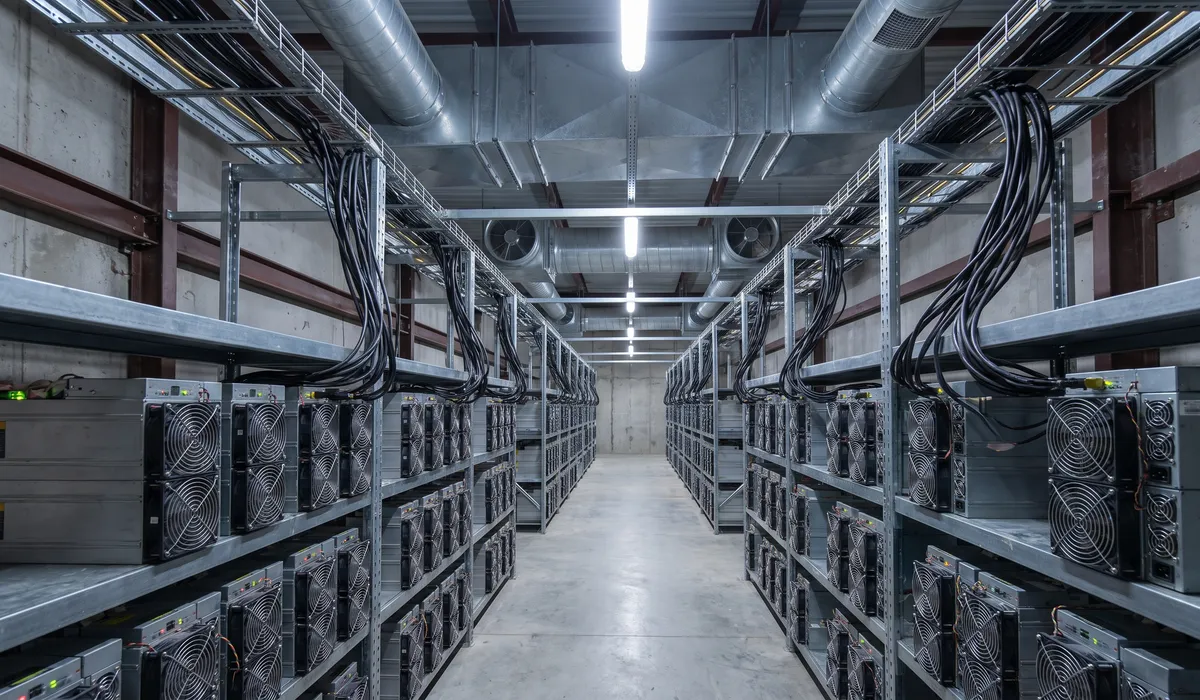
- To invest in Bitcoin is to trade fiat currency and receive BTC assets in return to keep and store
- It's possible to buy smaller parts of Bitcoin since there is no minimum investment required.
- Regular purchases can spread entry points, but neither a strategy nor a secure wallet guarantees a profit.
You can invest in Bitcoin by purchasing tokens from exchanges or brokers, or you can purchase regulated financial products that give you exposure to its price. There is no right way to approach investing, but there is a right way to keep it secure. Let's explore how.
Ways to invest in Bitcoin
Buying and trading Bitcoin all stem from a single action of first having Bitcoin and then choosing what to do with it. The main ways to invest in Bitcoin are buying BTC on a crypto exchange, using ETFs to get exposure, using Bitcoin futures contracts and finally acquiring shares to Bitcoin companies.
Buying Bitcoin directly
When you buy Bitcoin from a crypto exchange, you get full ownership of the asset and you can transfer it to your own wallet or keep it stored on the exchange. Where you store your assets matters since on an exchange you don't control the private keys.
Transferring it to your own wallet, where you have full ownership of the private keys, is where you have control over your Bitcoin. Even though both types of storage display the same BTC, they don't define ownership the same way.
Buying Bitcoin ETFs
Bitcoin ETFs and other financially traded products give you exposure to BTC assets through a security bought through a brokerage account. You don't have full ownership of the asset. What investors get is ownership of a regulated security which can be bought, sold or held.
Spot and futures work differently, with the latter representing a contract with the promise to sell it at a later time. When buying spot ETFs, investors can simply hold the asset without having to sell it.
Bitcoin-traded stocks
As the name implies, these are stocks of companies that have some form of exposure to Bitcoin. They either have it on their balance sheet, mine Bitcoin, or transact in Bitcoin. The most popular example is Strategy, which has continued to purchase BTC over the past 10 years.
To learn more about ownership, we built a guide to help illustrate how the *types of investments* and returns differ across financial assets.
How to invest in Bitcoin for beginners
Someone who is new to Bitcoin needs to first understand what Bitcoin is, how a wallet works, what the risks are, which providers are safe, choose the exposure, fund the account and make the purchase.
If you just heard of Bitcoin, the entire process can feel intimidating. So we're here to break it down.
- Understand Bitcoin: Too many people invest blindly and end up losing. Beginners need to understand how Bitcoin works and what it does at a basic level.
- Find a broker or exchange: Explore the list of crypto exchanges or investment platforms and read what kind of purchase you are making.
- Verify provider: Verify the provider to prove it's trustworthy by checking their authorization, payment terms, and customer feedback to avoid getting scammed.
- Set up account: Register the account using your personal details and complete the identity check to have full access to the account.
- Fund account: Fund the account with the amount you want to allocate to buy Bitcoin - either ETFs, the asset
- Learn how to use a wallet: Take time to set up a Bitcoin wallet where you have access to your own keys. Keep the private keys safe and create a back-up.
- Make the purchase: Bitcoin is divisible, so you don't need to buy an entire coin. You can buy fractions if you buy spot.
What does it cost to invest in Bitcoin?
Buying and investing in Bitcoin means you're spending capital but you're also spending money on fees, spreads, card processor fees and withdrawals.
"Zero commission" headlines on platforms are just marketing levers. Crypto exchanges use that to waive fees for first-time Bitcoin buyers, but they don't waive fees for deposits, withdrawals, spread, etc.
Trading costs versus ongoing costs
Bitcoin trading costs are different depending on how and where you trade. Costs appear when you place a trade, while ongoing costs can reduce the value of a product throughout the holding period.
A hypothetical fixed €2 purchase charge takes 2% of a €100 purchase but 0.2% of a €1,000 purchase. This is an illustration, not a provider tariff or a reason to invest more. It shows why small purchases need their own cost comparison.
A platform’s withdrawal charge is also not necessarily the Bitcoin network fee. Network fees depend partly on transaction data size and demand, rather than simply the cash value transferred.
Should you invest in Bitcoin all at once or regularly?
When you invest regularly you are doing DCA, which means averaging the cost of your Bitcoin as the price of the asset fluctuates. Investing everything all at once exposes you to price changes immediately, meaning you could be buying BTC at the peak and possibly have to wait longer to reach the same level.
Dollar-cost averaging means investing a fixed cash amount at regular intervals. It can make a schedule easier to follow, but it cannot prevent losses or guarantee a better result. The price path also matters, even when the final price is identical.
Investing money as you earn it is also different from delaying investment of money already available.
Consider €300 of available capital, invested either all at once or as three separate purchases:
In both examples, Bitcoin finishes 20% above its starting price. Regular buying does better in the first example and worse in the second.
Calculations value all BTC immediately after the third purchase. They exclude fees, spreads, taxes and interest on uninvested cash. These are invented scenarios, not historical results or forecasts.
Is Bitcoin safe? Understanding investment risks
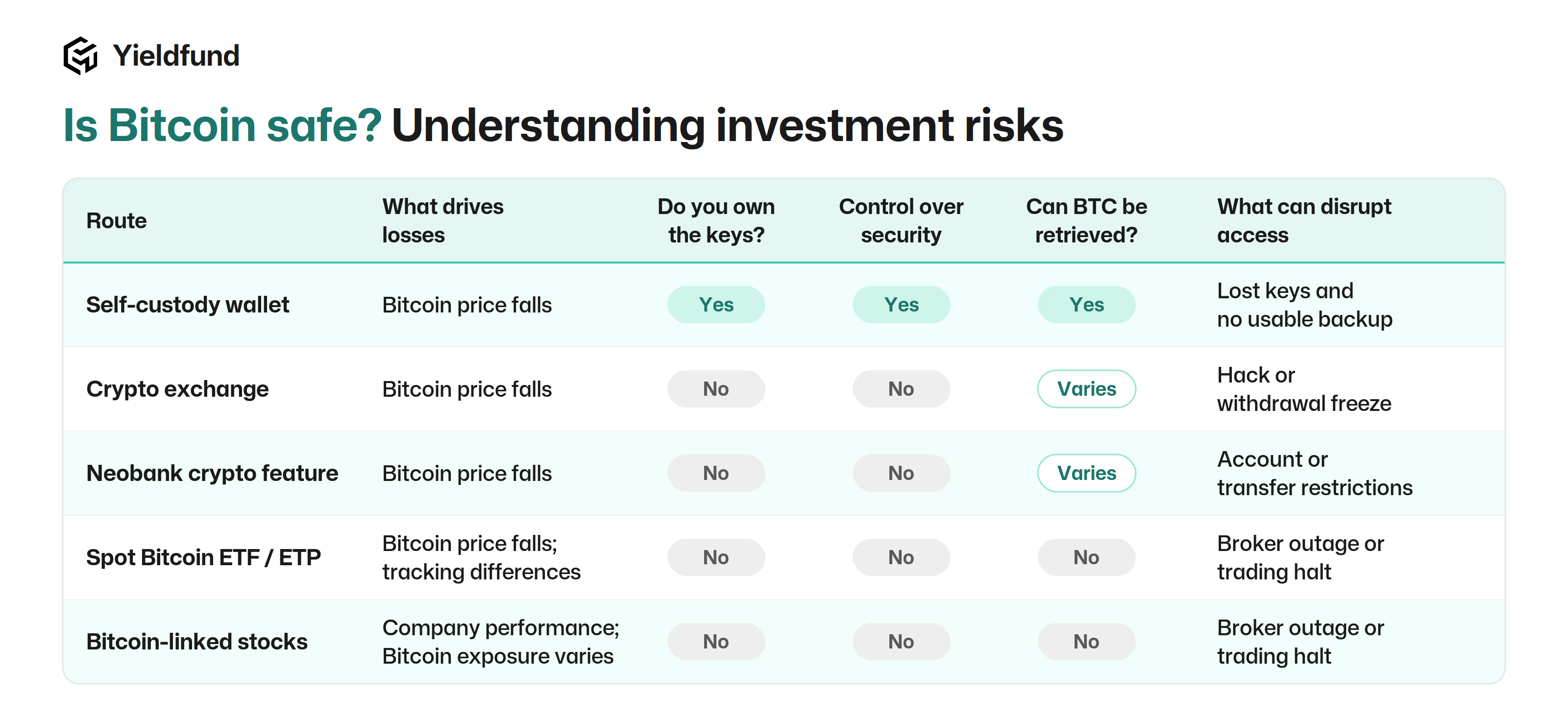
Bitcoin's technology is secure, but because it trades on financial markets, it carries more investment risk than security risk.
Hacking Bitcoin or its network is difficult, though not impossible. An attacker would need to control 51% of the network. The bigger risk lies in the services built around it, such as exchanges and financial instruments.
Wallets or accounts that store BTC can still be exploited through no fault of the user. Bad code, malware or directed attacks can drain wallet or exchange funds. This has happened and is one of the main concerns of holding large assets on exchanges.
Equally, rising or falling markets can affect investments. It doesn't require a hack for BTC to lose its value, so the risks become twofold: security and market risk.
How to store Bitcoin: custodial accounts and personal wallets
A custodial account puts key management with a provider; a personal self-custody wallet puts that responsibility with you.
When you use exchanges, third parties and centralized wallets - access and ownership depends on the provider's security and ability to honour withdrawals. With self-custody, you are in control of all your BTC, but losing access to your private keys means losing all the funds, without the possibility of ever recovering them.
There is no universal balance at which a wallet automatically becomes the right choice. The decision involves withdrawal costs, provider exposure and your ability to manage recovery securely.
Which strategies should not be confused with buying Bitcoin?
Leveraged trading, copy trading and yield products introduce arrangements beyond simply buying and holding BTC.
A derivative can give price exposure without asset ownership as investors purchase contracts rather than the coin. Copying another trader adds dependence on their decisions. A service promising income from Bitcoin needs a separate explanation of how it generates that income, who owes it and what can go wrong.
Spot and derivatives trading are not interchangeable and you should know the difference to understand what you own and what you don't before you think of investing in Bitcoin.
Before you invest in Bitcoin
Before considering to invest, you should know what you own, how it works at a basic level, what fees you'll pay and what risks you're taking - financial or technical.
The asset is volatile by default, so before you invest in Bitcoin learn about how the price has fluctuated. Even though it increased more than the stock market, it also dropped more than the stock market.
If you want simple exposure without learning how Bitcoin works, and you want to get exposure to Bitcoin yields without manual trading, Yieldfund has a solution. With yearly plans and weekly payouts, investors can generate returns without touching trading or thinking about "platform fees". Find out more about how Yieldfund works.
About the authors

Written by
Vlad Hategan
SEO content writer
Writes the articles in the Yieldfund knowledge base.
Dutch, English, Romanian

Translated by