


- Day trading platforms vary by trading instruments, broker connection and costs
- Trading platforms have both mobile and desktop interfaces for easier access from everywhere
- The total costs of day trading need to account for fees, spreads, and tools used
- MetaTrader is a day trading tool for expert traders to automate their trading strategies
If you’re active in financial markets, day trading platforms let you stay connected to the market at any time; you can set budgets and trade from almost anywhere. If you’re starting or looking for updates on new platforms, we’ve got you covered.
This guide focuses on European account options. Check residence eligibility and decide whether you want to own securities or trade derivatives before comparing interfaces.
What is a day trading platform?
Day trading platforms are digital platforms for tracking, opening, and closing market positions in the same day. They’re digital interfaces that route information from brokers and make it visible to traders during trading hours.
Simply put, it’s like any trading platform most investors are used to; the only difference is the types of markets brokers offer. Every platform has the same core features such as tools, charts, and data, but what separates them is who owns the app.
Best day trading platforms at a glance
The shortlist of the best day trading platforms shows where each platform shines, what kind of instruments are available for traders, and what geographical restrictions each application has in the EU.
The best day trading platforms reviewed.
In our review of the best day trading platforms, we scored each platform from 0 to 10 based on information on the operator’s page. Our brief review focused on trading tools, usability, market access, costs, and demo accounts. As always, this review is for information purposes, and trading can incur losses.
1. Interactive Brokers
Rating: 9/10. Interactive Brokers is one of the strongest options for experienced traders who require broader order control over their financial instruments. This means ETFs, options, and futures are all available, with market depth, configurable layouts, and express routing options. You can also paper trade and use demo accounts to learn the interface before committing any capital.
The trade-off is complexity. Permissions, market-data subscriptions, and commission plans require more attention. What’s important is that Interactive Brokers Desktop has a different interface than the mobile version and has some limitations. Our score reflects how capable the platform is for day trading.
2. SaxoTrader
Rating: 8.5/10. SaxoTrader is built for chart-heavy trading. It makes visualizing positions and organizing trading sequences easy, and the Desktop version adds depth trading, time-and-sales, and multi-screen layouts. The mobile interface is better suited for flexible routing, and traders can access stocks, ETFs, bonds, options, futures, and even forex.
SaxoTrader's appeal is its balance of ease of use and usability, but it comes with minimum commissions, optional data, and local fees. These make frequent trading - especially in day trading- more expensive.
3. TradingView
Rating: 8.5/10. TradingView earns its place in the list for its chart analysis features, watchlists, alerts, and strategy development. The platform suits analytically driven traders, and it uses the same interface as many other day trading platforms. It provides the backbone for other brokers, and traders can use it to compare charts and review hypotheses before placing any trade.
The limitation is that it’s not a suitable dedicated brokerage account. Instruments and order functions depend on the connection, and a paid subscription doesn't automatically provide real-time exchange data. The score suggests the platform is indispensable for experienced traders but still needs other brokers for order placement.
4. IG
Rating: 8/10. IG offers both mobile and desktop apps that suit traders who want to set alerts and manage CFDs in a single interface. In the EU market, it focuses on derivatives trading rather than direct asset ownership.
Regular tools found on other platforms, such as stop orders, don’t guarantee execution prices as reliably as on other platforms. The platform is rated for its practical management tools and available connections. Costs deserve attention: CFDs come with commissions, while other markets use spreads, and overnight financing still applies to longer trades. So compare the cost of your intended instrument, not the smallest advertised spread.
5. CMC Next Generation
Rating: 8/10. Next Generation is a strong candidate for traders who rely on detailed CFD charts, pattern recognition, news, and market-sentiment tools. Mobile access lets traders manage and monitor orders, though they must check which desktop functions they can replicate on a smaller screen.
The platform’s strengths are analytical depth and order management. Its main drawback for smaller share-CFD positions is the minimum commission: the Irish tariff lists 0.10%, with a €9 minimum, for most share and ETF CFDs. Thus, opening and closing a small qualifying position can cost €18 before other charges.
6. XTB
Rating: 7.5/10. XTB suits traders who prefer analysis and manual order management within one provider’s interface. Charts and stop-loss, take-profit, and trailing-stop controls cover useful everyday tasks. The platform offers stocks and ETFs along with some CFD instruments.
What matters most are the fees. Currency conversion can cost 0.5%, weakening the appeal for frequent cross-currency trading. Custom automation is another limitation: XTB does not support Expert Advisors, and the platform suits everyday traders better than dedicated expert traders.
7. Trading 212
Rating: 7/10. Trading 212 is a useful starting point for straightforward stock and ETF orders through its Invest account. Its appeal is accessible web/mobile trading with no dealing commission, but a 0.15% currency-conversion fee applies when conversion is needed. It offers few options for extra margin or futures funding.
Our lower score reflects the limits for advanced day trading: Invest does not support leverage or short selling, and it is not an exchange-futures account. Its separate CFD service has different costs and restrictions on scalping in specified circumstances.
8. Plus500
Rating: 7/10. Plus500’s proprietary platform is worth considering for manual CFD trading with charts, alerts, a demo account, and straightforward position controls. They offer exposure to several EU markets, but they don't offer an API for bot integration or automating scalping strategies.
Plus500 doesn’t charge commissions, but spreads, overnight funding, and other applicable charges affect results. The decisive limitation is strategy compatibility. The lack of scalping or arbitrage narrows day-trading options more than its accessible interface might suggest. We rate it for manual use, not every form of intraday trading.
Day trading platform comparison: mobile, fees, futures and margin rates
These are specific tariff examples, not universal prices. Futures commissions are per contract, per side, while margin rates refer to borrowing interest or CFD financing. Not the collateral required to open a position.
Which apps are best for automated day trading?
cTrader from Pepperstone and MetaTrader are the strongest tools for running automated strategies. They still require a broker connection, but based on our findings, MetaTrader is one of the most widely accepted for those who want to learn how automation tools work, and cTrader supports custom strategies, while MetaTrader uses Expert Advisors.
Both options are external, but IG also offers integrated services. IG's ProRealTime lets you build, test, and run strategies on the platform. Obviously, there are software and hosting charges that apply.
The real costs of day trading platforms
You need to calculate the real cost of day trading, including all fees, spreads, commissions, conversions, and funding rates. It needs better tracking; otherwise, any trader can assume they’re profitable when they actually aren’t.
In low-liquidity scenarios, slippage changes how much you end up with when you open or close a trade. Add market maker fees and conversions, and you can lose 10-20% of your total trade value.
The advertised commission is only one part of the bill. Compare spreads, commissions on both sides, currency conversion, data subscriptions, borrowing, and any platform fees. Slippage also changes the price you receive.
What matters also is the turnover. For ten €5,000 trades and ten €5,000 sales, XTB traders reach the monthly allowance even when they reuse the same capital. Afterward, they start paying extra fees on any other trade they make. When trading CFDs
Ranking the best day trading apps. From beginner to expert
Choosing a platform isn't easy, so we rank platforms by trading level and experience, focusing on learning complexity rather than advanced tools or other features.
For beginners, we chose Trading 2021 because it has a simpler interface for learning how to trade and offers demo accounts as well. When using full portfolios, traders can’t borrow or short, which makes it ideal for beginners.
For intermediate traders, we opt for either TradingView or XTB. While TradingView has limitations on how you can place orders, it makes analytical instruments easier to find, use, and integrate into strategy simulations. XTB also ranks here because you can run manual trading wihtout going through the complexities of automation.
For experienced day traders, our pick is Interactive Brokers through their TWS interface. It’s designed for institutional traders and provides multi-asset controls across many financial instruments. One strength is its ability to integrate algorithmic modules with custom API access for bespoke strategies.
6 steps to start day trading
Day trading isn’t something you pick up overnight. Instead, it’s a continuous learning process that requires traders to commit capital and follow or develop their own strategies. The first step is learning the instruments, financial theory, market movements, and understanding indicators. We wrote a longer piece on how to start day trading, so check that out as well.
Once you have the basics covered, here are the 6 steps to start day trading:
- Choose an instrument: Look at the market and instrument you’re about to use. Choosing between buying an asset spot and trading a derivative affects your risk and the total profit you keep.
- Check the account: After you choose, review the options available in your region. Our list already shows which platforms offer EU eligibility, but double-check to avoid account closures.
- Develop a trading plan: Use your market knowledge to write down your trading plan. This means defining entry conditions, where you set stop-losses, the maximum drawdown allowed, and when to stop for the day.
- Practice on a demo account: Almost every broker and trading platform offers a demo account where you can follow the same price action but use fictional capital to avoid losing money due to a lack of understanding. Here, you can test entries, exits, and order cancellations.
- Execute trades: Fund your account, choose the trading pairs or markets, and follow your trading plan.
- Review results and performance: After the first few trades, look back on how they performed. If you’re running manual strategies, look at when you place orders, what your triggers were to exit positions, and distinguish which trades were successful and why.
What to look for when selecting a day trading platform
Here’s what to consider before you even think about day trading. Follow the checklist below to avoid unpleasant surprises once you commit capital.
- Strategy fit: confirm scalping rules, short-selling access, and automation support. Permission to place intraday orders does not mean every method is allowed.
- Usable controls: test the functions you need on your actual device. Mobile access can be useful without matching a desktop platform’s depth.
- Account and data: check the legal provider, residence eligibility, product permissions, and live-data coverage. An English website alone does not establish access.
- Practical budget: distinguish the opening deposit from trading capital and required collateral. Allow for fees and losses; the lowest deposit is not a recommended starting balance.
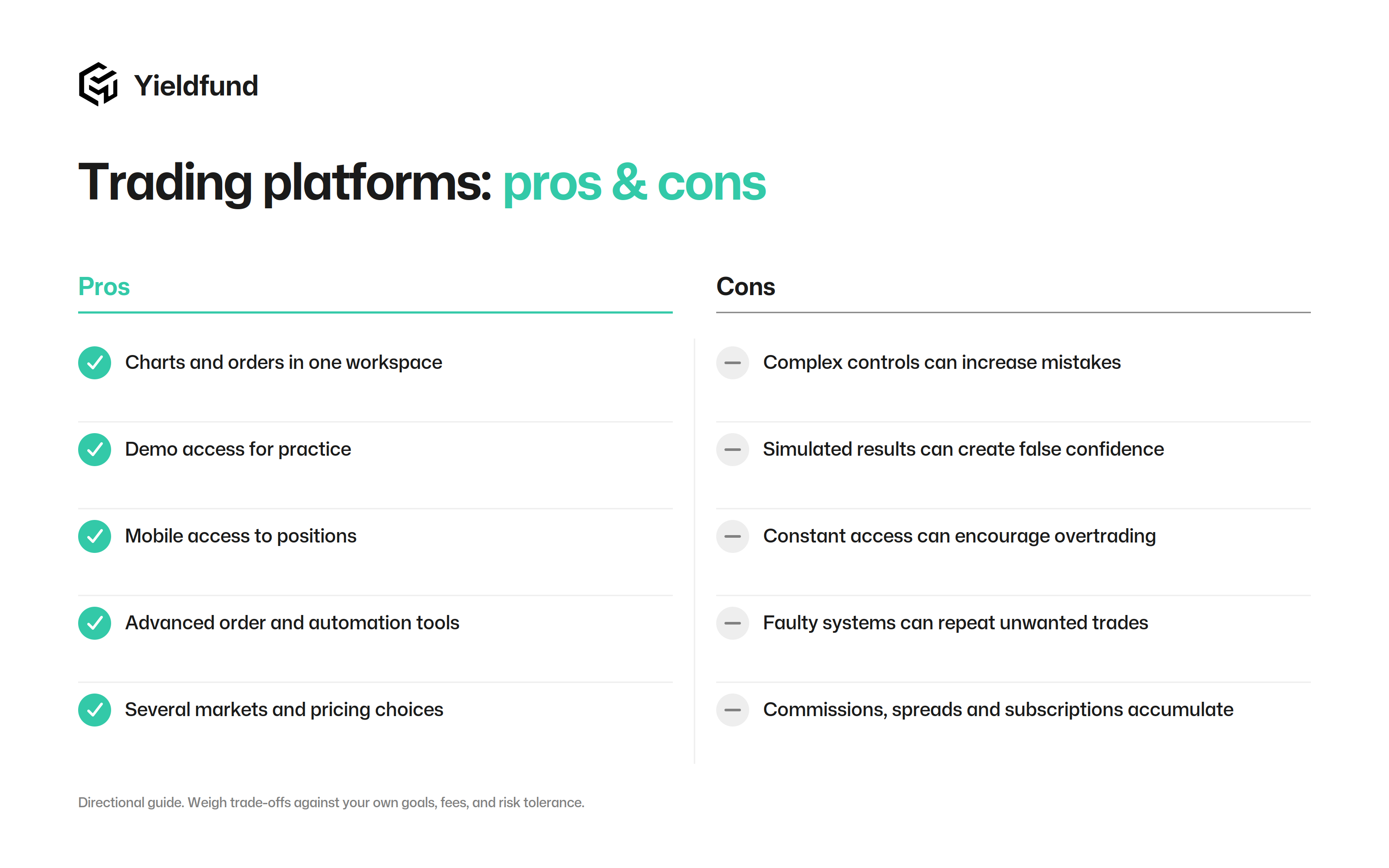
Pros and cons of day trading platforms
Closing the loop on day trading platforms
When you go into day trading, what matters most is how you manage extra costs in your overall trading budget. So it becomes paramount to analyze every platform in terms of the financial products offered, fees, and restrictions.
The impression now is that day trading is easy, and that’s because so much information is available. In fact, only a small number of people can be successful in day trading because it requires a heavy time commitment and capital. If you still want exposure to financial markets, including crypto, without trading yourself, Yieldfund offers investment plans with weekly payouts where you reap the rewards of their trading algorithms, so you don’t spend time learning the complexities of trading and investing.
This is not investment advice, and always do your own research before making any decisions.