

- Identify who pays the return and what they receive in exchange.
- More tokens do not necessarily mean a more valuable investment.
- Compare fees, withdrawal conditions, and risks alongside APR or APY.
- Stablecoin income comes from an earning arrangement, not simply holding the token.
Crypto passive income is when crypto is used across the ecosystem to generate rewards and payments through on-chain activities. There’s more than one way of earning from crypto, and this part of the article helps traders understand how and where it works.
What is crypto passive income?
Crypto passive income is payments, yields, and rewards from crypto-related activities that require no or limited active trading, monitoring, or involvement once tokens are locked.
Income is generated in the form of other crypto tokens, and “passive” only describes the workload of the process and not the safety or the guarantee of the entire process. A form of crypto passive income is DeFi staking, where assets are locked on protocols and users receive yields based on protocol trading activity.
The process covers almost all cryptocurrencies on the market - especially those with high market cap or liquidity- and the process of passive income from crypto differs between a token’s appreciation and additional tokens as a reward.
How does crypto passive income work?
Passive income from crypto happens when token or asset holders use on-chain products to support the ecosystem. In return, the protocols or companies distribute tokens in the form of rewards based on pre-existing rules.
In some cases, there is a need for validators to approve token distribution. In other cases, such as Airdrops, rewards are distributed for on-chain and off-chain activities and don’t require full validator approval. Companies can owe payments under fund, loan, or bond agreements.
In all cases, there is a binding contract or smart contract that lists the rules of participation as well as for claiming rewards from stakes, stores, or used assets.
How to earn passive income with crypto
Crypto returns in the form of passive income can be earned by contributing to the ecosystem or even investing through companies. In all cases, users need to allocate tokens to receive rewards, and only in a few cases is that possible without using their own capital.
You can earn crypto-related income through the following methods, although their workloads and payment reliability differ.
Crypto staking
Staking commits a proof-of-stake asset to supporting its network. Running a validator requires technical work; delegation, pools, and services can reduce that workload. Liquid staking provides a receipt token representing the position, but selling it and redeeming the underlying assets can involve different prices and waiting periods.
DeFi Lending
DeFi lending supplies assets to smart contracts that make them available to borrowers. Rates can change with borrowing demand. Aave’s supply documentation explains this mechanism. Using supplied assets as collateral for a loan introduces additional obligations.
Liquidity provision
Liquidity providers supply assets that others trade against and can receive a share of transaction fees. Some pools also distribute incentive tokens. Concentrated-liquidity positions require particular attention: if the market leaves your selected price range, the position stops earning trading fees until conditions change or you adjust it.
Crypto mining
Crypto mining relies on mining tools to secure proof-of-work networks and earn rewards. Rewards and profits depend heavily on electricity costs, equipment, maintenance, and other hidden costs. Also, access to rewards is limited, and profitability is linked to the token value. Mining is generally closer to running an operation than leaving money in an account.
Crypto vaults
Crypto vaults are similar to automated strategies here; a protocol collects rewards and reinvests them. They help reduce repetitive transactions; however, the underlying risk of lending and liquidity exposure remains the same. Crypto vaults charge fees for managing allocations, so it’s important to read which protocol vault has better fees and performance.
Crypto investment companies
Investing to get exposure to crypto through a company reduces day-to-day management and even removes the entry barrier. A fund or corporate bond can distribute payments based on the company’s exposure to crypto through investments or trading. Yieldfund distributes weekly payments to investors who can access investment plans of up to 3 years. The difference is that the agreements pay fixed interest and are not automatically a direct share of its trading profits.
Airdrops
Airdrops distribute tokens to eligible users, sometimes following some sort of participation in the project. Users can contribute to the project, use the protocol in testnet, and even interact with the platform off-chain. Completing repeated tasks to qualify is active work.
What to look for when choosing a crypto passive income method
Choose a method by comparing its payment source, costs, withdrawal rules, and demands on your time.
Start with four questions:
- What do you own? Tokens, a pool position, a fund share, or a contractual claim?
- Who controls the assets? You, a smart contract, a custodian, or an investment company?
- What does an exit require? A waiting period, available liquidity, repayment of borrowing, or a sale?
- What remains after costs? Include service charges, network fees, conversion spreads, and applicable taxes.
Match those answers to the assets you actually want to hold. Buying an unfamiliar token solely for its advertised rate adds a separate investment decision. Our investment-types guide explains the ownership differences.
APR vs APY: What the advertised rate tells you
APR expresses an annual rate without compounding, while APY includes compounding under stated assumptions.
For example, a constant 6% APR compounded monthly produces approximately 6.17% APY. An illustrative €1,000 would become about €1,061.68 after one year, assuming unchanged asset prices and no fees or tax.
That calculation changes if rates fall, rewards cannot be reinvested immediately, or claiming them costs money. Spending rewards also prevents their reinvestment.
Check whether the advertised figure includes temporary incentives and whether charges have already been deducted. An annualized recent rate is not a future commitment. Our compounding guide explains the calculation.
How much money do you need to earn crypto passive income?
Someone can earn passive income from crypto with as little as $1 or more, since protocols have few limitations for DeFi staking, but gas fees make returns lower. Other processes can require some upfront capital. For example:
- DeFi staking: Start from $1
- Liquidity provision: Requires a minimum of 10-50 for both pairs
- DeFi lending: Higher minimum of $10, but depends on the platform.
- Crypto mining: Minimum $5000 to cover the costs of the equipment
- Crypto investment companies: $10,000 - $100,000
Small balances can be particularly sensitive to fixed transaction charges. Calculate the expected cash amount before deciding whether the setup and monitoring are worthwhile.
Best cryptos for earning passive income with crypto
The best cryptocurrencies for earning crypto passive income include Ethereum (ETH), Solana (SOL), and USDC (USD Coin). While they all serve different purposes, they can have the same exposure across the ecosystem.
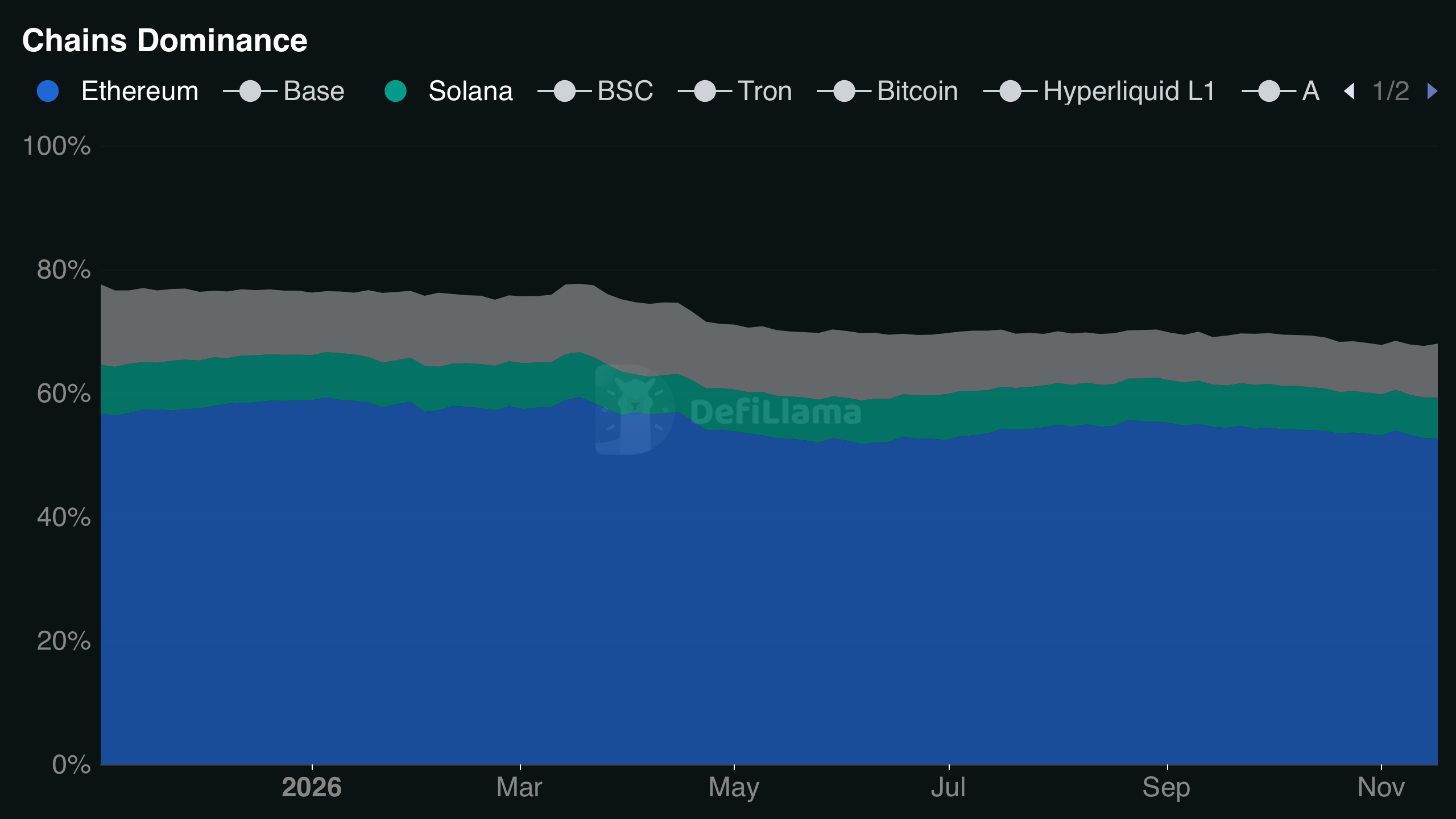
We chose the three tokens as an example since they are the ones that are more frequently used networks. According to DeFi Llama, Ethereum and Solana account for 58,96% of the total value locked across the entire on-chain ecosystem.
Ethereum
Ethereum supports staking rewards for participating in network security. Activating your own validator requires at least 32 ETH, while pools offer access with smaller amounts. Compare the operating work, fees, and provider dependencies. Returns remain exposed to ETH’s price.
Solana
SOL holders can delegate stake to validators. Rewards depend on network conditions, the amount staked, validator uptime, and commission. Compare those factors with activation and withdrawal rules rather than selecting the highest displayed percentage. Liquid staking adds contract and receipt-token considerations.
USDC
USDC targets the US dollar’s value and does not itself generate interest for holders. Income requires a separate arrangement, such as supplying it to a lending protocol. That creates exposure to both the token and the earning product. Circle makes this distinction in its USDC documentation.
How to earn passive income with stablecoins
Stablecoins are better than native chain assets like SOL and ETH because they are less volatile. Stablecoins have a 1:1 parity with USD and use reserves to maintain the peg. As a result, even when trying to generate passive income from crypto, the value of the asset doesn’t fluctuate.
DeFi products for stablecoins like USDC or USDT offer much lower APY because they are more widely used and there's less on-chain demand for them. Even so, dollar stability also differs from stability in your spending currency. A dollar-linked balance can lose euro value while maintaining its dollar peg.
The risks of using crypto for passive income.
Since crypto rewards can vary, they also carry inherent risks that many fail to fully grasp. In most cases, high APY pulls investors into buying new tokens and using less-liquid protocols.
Third-party interference, market volatility, your own accountability, and FOMO can affect your capital. Here are the main risks:
- Impermanent loss: Token price loses value while assets are locked in smart contracts
- Black swan events: Markets tank and the value of assets and rewards is below the purchase price.
- Hacks: Capital can be drained from smart contracts if there is an attack on the protocol or exchange
- Vault failure: The strategy is not performing, and you’re using part of your investment
- Issuer default: Market conditions can cause the fund to close down
- Phishing: Phishing attempts can drain wallets and accounts
Finding crypto income opportunities
Crypto has a steep learning curve, but that doesn’t mean it's impossible to generate passive income from crypto. When you have a basic understanding of the system and how to stay safe, you’re then able to access income opportunities that are different and at times more rewarding than in traditional finance.
The approaches can still expose capital to financial losses. What matters is understanding the risks, not allocating all your capital, and using these tools to diversify rather than putting all your finances in a single basket.
Frequently asked questions
Can you earn passive income just by holding Bitcoin?
Holding Bitcoin doesn’t pay native staking interest since BTC uses proof of work. To generate Bitcoin yields, you need to use other activities such as lending or another protocol arrangement.
Is USDT or USDC staking the same as blockchain staking?
Holding USDT or USDC doesn’t itself earn native proof-of-stake validator rewards. If a service markets “stablecoin staking,” check whether the payment comes from lending, liquidity provision, promotional rewards, or another activity, and assess that arrangement’s terms.
About the authors

Written by
Vlad Hategan
SEO content writer
Writes the articles in the Yieldfund knowledge base.
Dutch, English, Romanian

Translated by