

Compound interest means earning interest on your original amount and on interest previously added to that amount. So how does it work in practice? Interest earned in one period stays in the balance, so the next period's interest is calculated on a larger amount.
It's a powerful idea and this guide explains the formula, compares compound and simple interest, shows what can strengthen or weaken compounding.w
What is compound interest in simple terms
Compound interest is the interest you earn not only on your original amount but also on the interest already added to it. Each period, previously earned interest becomes part of the base for the next calculation. In most cases, financial institutions describe it as “interest on interest.”
Let’s take an example of €1,000 which earns a hypothetical 5% interest rate once a year:
- In year one, the interest is €50, so the balance becomes €1,050.
- In year two, the 5% rate applies to €1,050 rather than the original €1,000. The interest is €52.50, so the balance becomes €1,102.50.
- In year three, interest is calculated at €1,102.50.
The increase is small at first because the previously earned interest is still small. As the balance grows, the amount on which the next interest calculation is based also grows.
Three terms are important:
- Principal: the starting amount.
- Interest rate: the percentage applied during a stated period.
- Compounding frequency: how often earned interest is added to the balance and begins earning interest itself.
Compounding is a calculation method, not an investment guarantee. A formula can show what would happen at a constant rate, but it cannot make a variable investment return predictable.
Compound interest calculator: calculate future balance
Use the compound interest calculator to estimate how an initial investment could grow when you reinvest previously earned interest.
Enter the following information:
- Initial investment: The principal amount you start with.
- Additional contributions: Any amount you plan to add regularly.
- Annual interest rate: The hypothetical yearly rate applied to the balance.
- Investment period: The number of years the money remains invested.
- Compounding frequency: How often interest is calculated and added, such as annually, monthly, or weekly.
The calculator estimates your final balance, total contributions, and accumulated interest. For example, an initial investment of €5,000, followed by monthly contributions of €100, would grow to approximately €23,763 after 10 years at a hypothetical 5% annual interest rate compounded monthly. Of that amount, €17,000 would represent the initial investment and contributions, while approximately €6,763 would come from compound interest.
The compound interest formula
The standard compound interest formula is: A = P(1 + r/n)^(nt)
For example, if we imagine a €5,000 earning on a hypothetical 10% annual rate, that compounds every year for approximately 30 years in total, then the calculation is as follows:
€5,000 × (1 + 0.10/1)^(1 × 30) = €87,247.01
The assumption is that there are no additional contributions, fees, or any other taxes in the process. What’s worth understanding is that at an unchanged 10% rate, the example is a mathematical illustration, not a forecast or guaranteed return.
If compound capital is added or withdrawn during the terms, each cash flow comes with different amounts of time to compounding and has to be included separately.
For a quick estimate, the Rule of 72 approximates how long an amount may take to double, and it’s done by dividing 72 by the expected annual rate. For example, at 9%, the estimate is eight years.
How compounding works at Yieldfund
Yieldfund offers optional partial reinvestment for each bond, and investors can decide for themselves if they want to reinvest or select a percentage of the weekly interest payment, up to a maximum of 50%.
When using Yieldfund, compounding means that interest initially paid out weekly is added to the investment amount and the interest is then calculated again on the total amount that is “invested”, all in accordance with the Declaration of Purchase, Bond Terms and Conditions and compounding addendum.
The portion not selected for reinvestment continues to be paid weekly on the first business day of the week, usually Monday.
If we take a practical example of a €100 weekly payment, with 50% reinvested, then €50 would be paid, and €50 would be deferred under the agreement.
At the end of the term, the amount invested with Yieldfund and deferred interest are paid out, including the interest that was created by allocating the difference in amount.
Compound interest vs. simple interest
Simple interest is calculated only on the original principal. Compound interest is calculated on the principal plus interest already added to the balance.
Using a €5,000 starting amount and a hypothetical 5% annual rate for 20 years:
- With simple interest, €250 is added every year. The ending amount is €10,000.
- With annual compound interest, the ending amount is €13,266.49.
The rate and starting amount are identical, but the results differ because the compounded balance changes each year. With simple interest, the calculation base stays at €5,000. With compound interest, each year's interest becomes part of the next year's calculation base.
This does not mean that every product described as "compounding" is automatically better. Returns, risks, access to money, fees, tax treatment and contractual conditions must also be compared.
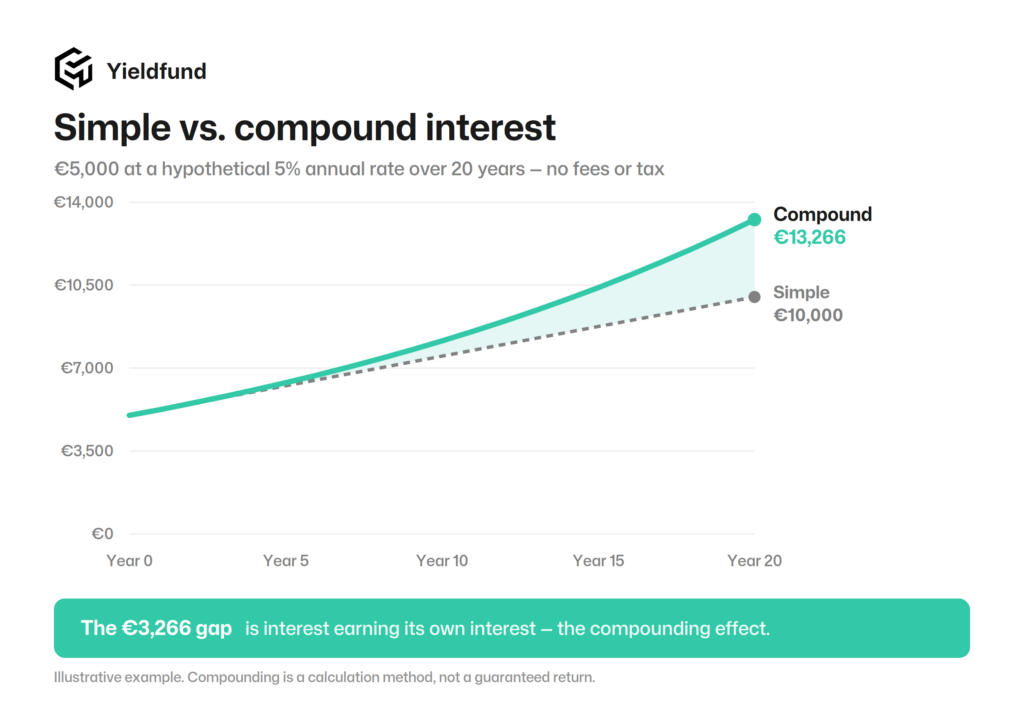
The compounding gap
In this example, both approaches start at €5,000 and use the same 5% rate. After 20 years, simple interest reaches €10,000 — but compound interest reaches €13,266.49. That extra €3,266 is interest earning its own interest. Over longer horizons and higher balances, the gap widens further.
How compound interest works on credit cards and debt
When interest compounds, it can increase the amount of savings someone has in their account, but it also makes debt more expensive. Unpaid interest on a credit card, for example, is then calculated again on both the principal amount and the accumulated interest.
It’s worth distinguishing between compounding interest and compound interest on debt. Taking the credit card example, interest is calculated daily using the card’s annual percentage rate. This means repayments, fees and changes to the credit card balance affect the amount charged.
On a €5,000 hypothetical balance with an annual interest rate compounded monthly, if no repayments are made, the balance would grow to €6,097 after a single year, for a total of €1,097 in accumulated interest.
Compounded interest matters for the type of financial agreement you follow; whether you are earning interest or owing interest.
- When you earn interest and leave it invested, compounding can increase your balance.
- When you owe interest and leave the debt unpaid, compounding can increase the amount you owe.
Compound interest vs. compound returns
Compound interest and compound returns are related but not identical. Compound interest usually describes savings accounts and fixed-interest products. Compound returns are broader: they can include reinvested interest, dividends, and capital gains from assets whose value can rise or fall.
Stocks, funds and cryptoassets do not normally pay a fixed, guaranteed interest rate. Their future returns are variable. What’s important to know is that products don’t necessarily compound because they pay interest or dividends; what matters most is what happens to those earnings.
Where can you earn compound interest?
Your capital compounds with interest on financial products that pay interest in an account. This can be banks, bonds, mutual funds, or even bank deposits. Every investors needs to acknowledge and be aware on how interest is accured - whether it's added automatically, paid out separately and how frequent.
Savings accounts
Banks pay out interest directly into users' bank accounts and offer lower interest rates. Leaving money in a savings account typically guarantees the account holder earns interest, which compounds. For example, banks such as ING and ABN AMRO have regular savings accounts with varying compounding frequencies.
Certificates of deposit
A certificate of deposit, commonly called a CD, holds money for an agreed period in exchange for a stated interest rate. Some CDs add interest to the balance so it compounds, while others pay the interest into a separate account. But withdrawing money before the end of the term may result in a penalty.
Bonds and fixed-interest products
Bonds usually pay interest to investors as a “coupon,” or as cash, so they can’t be compounded automatically. To create a compounding effect, investors would have to reinvest each payment, and companies such as Yieldfund are integrating a compounding feature to make it easier to compound existing returns.
Mutual funds and investment accounts
Mutual funds and other assets held in investment accounts usually generate compound returns rather than compound interest. Dividends, distributions, and capital gains can contribute to future growth when they remain invested.
What makes compounding faster or slower
The difference between quick or slow compounding varies based on variables that depend on investor behavior but also external factors such as taxes and available capital.
Time
Time gives previously earned interest or returns more opportunities to generate further growth. Starting earlier extends the number of compounding periods, but there is no universal year in which compounding suddenly becomes significant. The result always depends on the rate, cash flows, and costs.
Rate
At a higher positive rate, a balance grows faster. But higher expected returns commonly involve higher risk, and a high hypothetical rate should never be presented as certain.
Compounding frequency
When the same nominal annual rate is held constant, more frequent compounding produces a higher ending amount. The benefit has diminishing returns, however.
For example, €10,000 at a hypothetical 6% nominal annual rate for 10 years becomes:
- €17,908.48 with annual compounding.
- €18,214.89 with weekly compounding.
Contributions and withdrawals
Regular additions can increase the amount available to earn future returns. Withdrawals do the opposite: money taken out can no longer contribute to future compounding. A regular investing approach such as dollar-cost averaging can create discipline, but it does not protect against losses or guarantee a positive return.
Fees, taxes and inflation
Fees reduce the amount left to earn future returns, and even apparently small ongoing fees can have a major effect because they reduce the balance that remains invested.
Tax treatment varies by country. In the Netherlands (2026), savings and investments are taxed under Box 3 — but not on your actual interest. Instead, the tax authority applies a deemed return (6.00% for investments, a provisional 1.28% for savings) and taxes that at 36%, only on wealth above the tax-free allowance of €59,357 (€118,714 for fiscal partners). Because the tax is based on a deemed return rather than your real gains, its effect on compounding depends on your asset mix and balance.
The main point
Compound interest is not a shortcut. It is a mechanism: earnings remain in the balance and can generate further earnings. Time, rate, reinvestment, costs and withdrawals determine the mathematical result, while the product's risks and contractual terms determine what that result means in practice.
At Yieldfund, partial reinvestment makes that choice explicit. Investors can balance weekly interest payments with deferred interest that accrues under their agreement, up to the permitted percentage. The right setting depends on the agreement and the investor's own circumstances.
Frequently asked questions
What is compound interest in simple terms?
Compound interest means earning interest on the original amount and on interest previously added to that amount. It is commonly described as interest on interest.
Does compounding frequency matter?
Yes. At the same nominal annual rate, more frequent compounding produces a somewhat higher ending amount. The improvement becomes smaller as frequency increases, and rate, time, and costs often have a larger effect.
Does Yieldfund reinvest interest automatically?
No. The Yieldfund interest is not automatically reinvested, and investors can reinvest up to 50% of the interest paid out, while the not selected amount continues to be paid out.
About the authors

Written by
Vlad Hategan
SEO content writer
Writes the articles in the Yieldfund knowledge base.
Dutch, English, Romanian

Translated by
Patricia Van den Kerckhove
Senior content translator
Translates and reviews Yieldfund's content in Dutch.
Dutch (NL & BE), French, English