

- USDT (Tether) launched in 2014 and remains the largest stablecoin by market cap and liquidity
- USDC (Circle) launched in 2018 and is a MiCA licensed with better reporting publishing monthly reserve attestations
- Both USDC and USDT can lose their $1 peg during periods of high market stress and volatility
- Stabelcoin fees for USDT and USDC depend on the network and the medium used like wallets or exchanges
Stablecoins like USDC (USD Coin) and USDT (Tether) are two of the largest cryptocurrencies that are pegged 1:1 to the US dollar. The differences include who issues them, how they maintain parity, what their reserves include, and where they are regulated.
Differences between USDC and USDT
When trading or using cryptocurrencies, USDT and USDC are used to convert volatile assets like Bitcoin into a more stable denominator. The differences between the stablecoins are where they’re used, who issues them, their market valuation, and where they have a larger market.
The difference is that USDC is issued by Circle, a US company with short-term US Treasury reserves, while USDT is issued by Tether, a Chinese/US company that holds liquid assets including gold, Bitcoin, loans, and real estate credit as collateral.
Both tokens are chain-agnostic and can be integrated on several networks. The difference is where the companies chose to expand. USDC is available on EVM networks like Ethereum and Polygon, as well as Solana. Tether is also compatible with Ethereum and Solana, as well as Binance Smart Chain and Tron.
The main differences you need to know are:
- Where the assets can be used: Not every platform or company accepts every stablecoins.
- How they can be transferred: They can be transferred only on compatible networks.
- Are they available in Europe: Only USDC holds a MiCA license amongst the two, while Tether has not obtained a license in the EU.
USDC vs USDT differences in reserves and reporting
Circle reports that USDC is backed by cash and highly liquid dollar assets. These include short-term US Treasuries and overnight lending secured by Treasuries. It publishes weekly reserve disclosures and monthly independent assurance reports.
Tether’s September 2026 report shows a broader reserve mix. Treasury bills and repurchase agreements account for most of the backing, with additional holdings in gold, Bitcoin, secured loans, and other assets. Gold and Bitcoin introduce price exposure beyond short-term dollar debt.
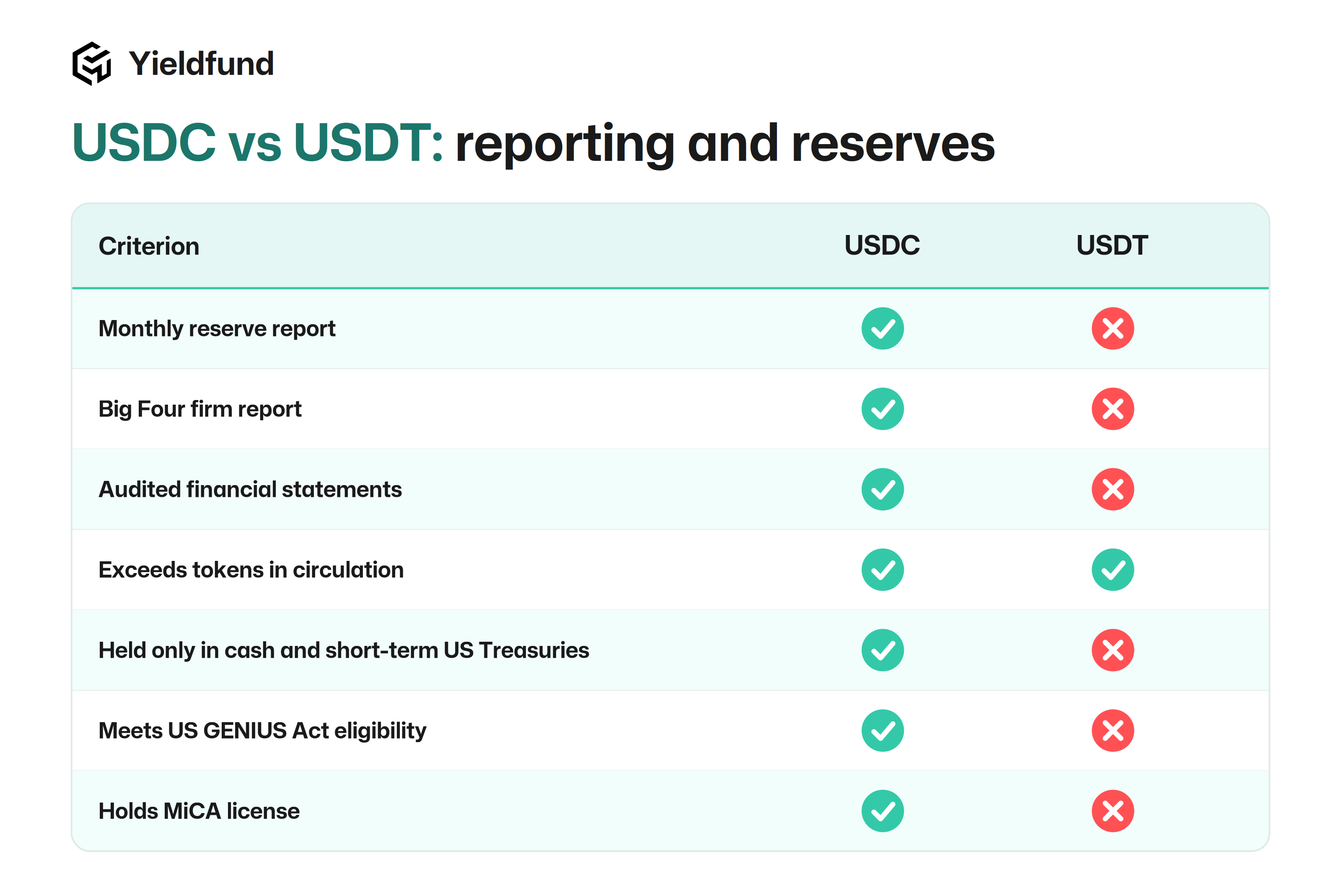
Which of the Two Is MiCA Licensed?
Circle secured an Electronic Money Institution license from France's ACPR in mid-2024, enabling USDC (and EURC) issuance across the EU under the Markets in Crypto-Assets (MiCA) framework. At the time, Circle stated that among the top 10 stablecoins by market cap, USDC was the only one that was MiCA-compliant.
According to the sources reviewed, Tether has not obtained MiCA authorization, and its CEO has publicly criticized MiCA's requirement that issuers hold at least 60% of reserves in European banks.
Binance delisted USDT (and other non-MiCA stablecoin spot pairs) for EEA users by March 31, 2025, while continuing to support USDC and EURC; users could still hold, deposit, or withdraw USDT, just not trade new spot pairs. Regulatory status can shift, so check your exchange's current listings and ESMA's public register before transacting.
How can you buy USDC with euros?
It’s possible to buy USDC through crypto exchange platforms that support it for your country. In the Netherlands and Europe, you can buy USDC through neobanks, brokers, and crypto exchanges, which involves identity verification, funding the account in fiat currency, and placing a euro-to-USDC order or accepting a conversion quote.
When users buy USDC using credit cards, they may incur extra charges of up to 3% for processing transactions.
Binance was the best place to buy USDC in the Netherlands, but since the platform does not have a valid license, the best platform has become Kraken, with fees as low as 2.7%. A supported purchase also doesn’t establish that the platform supports withdrawals on every network where USDC exists.
How do USDC and USDT fees compare?
Neither USDC nor USDT has a universal transfer fee. When you’re sending money from a personal crypto wallet, you only pay blockchain network fees, which vary depending on the network you choose. Exchange trading, on the other hand, means you’re paying separate fees.
On Kraken Pro, USDC/EUR trading starts at 0.20% for both maker and taker orders—€2 on a €1,000 trade.
On Bitvavo, USDC/EUR starts at 0.10% for both—€1 on a €1,000 trade. Higher trading volumes qualify for lower rates.
On Coinbase, spot fees start at 0.25% for makers and 0.50% for takers (€2.50 or €5 on a €1,000 trade).
These are its general spot rates; designated stablecoin pairs have separate pricing. Maker orders add liquidity to the order book, while taker orders execute against existing orders.
For EU users, availability also matters: USDT trading is unavailable on Kraken and Coinbase and was recently delisted from Bitvavo. That means EU traders have no direct USDC-to-USDT trading-fee comparison across these three platforms.
Where Can You Buy the Tokens?
Both USDC and USDT can be bought on centralized exchanges in Europe, with the latter having some access limitations. You can also buy stablecoins from neo-banks, which offer them as investment options, and through brokers that allow crypto trading.
The process looks like this:
- Create an account with your chosen exchange.
- Complete identity verification.
- Add a payment method (bank transfer or card).
- Purchase USDC directly, or convert USDC from your fiat balance.
Is USDC safer than USDT?
USDC offers more frequent reserve assurance and a MiCA issuance framework. These are meaningful differences, but they don’t guarantee a continuous $1 market price.
A stablecoin’s reserve backing is one part of a USDC vs USDT comparison. Tokens held on an exchange also depend on that platform’s operations. Self-custody means you manage wallet access, while bridged tokens add dependence on the bridge. Circle’s risk disclosures describe these market and operational risks.
Neither token is a bank deposit covered by ordinary deposit protection.
Can you convert USDC to USDT or euros?
You can convert USDC to USDT where a platform supports that pair for your location. The rate and charges determine the amount received, so one token doesn’t necessarily exchange for exactly one of the other.
To convert USDC into fiat currency, selling through an exchange and redeeming with Circle are separate routes. Circle’s MiCA terms give users a right to request redemption at par, subject to KYC checks and anti-money-laundering checks. Selling for euros through an exchange uses its price and fees.
A token swap also differs from moving an asset between blockchains. Sending USDT to a USDC deposit address doesn’t automatically convert it.
Are USDC and USDT good investments?
The scope of both tokens is to maintain the same value as $1 USD
Both aim to maintain dollar value. Their usefulness for payments or trading is separate from whether they generate a return.
Is USDC a good investment?
USDC can serve a purpose when you need dollar-denominated tokens for payments or settlement. Its intended $1 price leaves little scope for the capital growth investors seek from shares or other assets.
Is USDC a good investment for income? Holding it doesn’t entitle you to the earnings on Circle’s reserves. An interest-bearing account, lending product, or other yield offer has its own terms and risks. Circle makes this distinction in its MiCA white paper.
Is USDC a good investment for euro savings? The dollar exposure can change the result. Hypothetically, €1,000 exchanged at $1.10 per euro becomes $1,100. If the euro later buys $1.20, that balance converts to about €916.67, even if USDC stays at $1. The same currency exposure applies to USDT. This example excludes fees, tax, and yield.
Is USDT a good investment?
USDT can be useful for a trading pair or payment route that supports it. Tether’s token also targets $1, so its role centers on dollar liquidity rather than expected price appreciation.
Is USDT a good investment for European users? Platform restrictions can limit buying, selling, and transferring it. Global acceptance helps little when the service you need isn’t available in your location.
Is USDT a good investment through a yield product? You need to assess an advertised return through the provider’s lending or investment arrangements. USDT’s acceptance on trading venues doesn’t establish the quality of that separate product.
USDC vs Ethereum: what are you comparing?
USDC vs Ethereum usually means comparing USDC with Ether, or ETH, the Ethereum network’s native cryptocurrency. USDC is a dollar-pegged token that can run on Ethereum and other networks. ETH pays for network activity and helps secure Ethereum through staking, as Ethereum’s documentation explains.
The question “what’s USDC vs USDT?” compares dollar tokens from different issuers. USDC vs Ethereum involves assets with different price models: USDC targets $1, while ETH has a market price without a dollar peg.
The distinction also appears in a wallet. Sending USDC directly on Ethereum normally requires ETH for the network fee, unless a service sponsors or handles that cost. Holding USDC doesn’t mean holding ETH.
Making an informed decision
This guide is purely informational, and answering “what’s USDC vs USDT” for your own use starts with the service you need.
Your choice depends on whether you want to use it across European markets or trade external markets. Both stablecoins are tradable in most markets, while USDT fits new trading pairs, which are often highly volatile.
Whichever you choose, remember that both stablecoins have de-pegged briefly in the past and carry issuer, reserve, and regulatory risk. Diversification and risk management remain as relevant to stablecoin holdings as to any other part of your portfolio.
FAQ
Is USDC better than USDT?Neither is universally better. USDC offers more frequent reserve attestations and MiCA compliance in the EU; USDT offers greater liquidity and broader global trading support. The right choice depends on your priorities and risk tolerance.
How do I convert USDC to USDT or vice versa?You can use an exchange or a crypto wallet with swap features to convert one asset to another. You select the trading pair, confirm the exchange, and pay a small fee.
Is USDT currently MiCA licensed in the EU?Tether has not obtained MiCA authorization, while Circle has secured an EMI license covering USDC. Regulatory status can change, so confirm current standing with your exchange or ESMA's register.
Can both USDC and USDT lose their peg?Yes. USDT dipped to about $0.996 during the 2022 Terra collapse, and USDC fell to roughly $0.96 in March 2023 following its exposure to Silicon Valley Bank. Both recovered within days, but neither stablecoin is risk-free.
About the authors

Written by
Vlad Hategan
SEO content writer
Writes the articles in the Yieldfund knowledge base.
Dutch, English, Romanian

Translated by