

- Bitcoin was above the 200-day MA on October 15th, but remains 34% below its all-time high.
- A bear market in crypto is when the market is down more than 20% from its highs and sentiment is shifting.
- A bear market can last between 1 and 2 years before market sentiment recovers and new investors access the market.
- Bear markets recover after the four-year Bitcoin halving when there are fewer BTC assets and assets become scarce.
At the end of 2025, we’ve witnessed a new bear market in crypto as capital has rotated out of digital assets. Since then, the price of Bitcoin has dropped more than 20% from its ATH and investor interest has dwindled.
Update: Is there still a bear market in crypto? As of October 15th, 2026, Bitcoin signals remain mixed, with daily closing prices at approximately $82,116, which is 34.2% below its all-time high. Bitcoin remains above the 200-day moving average, which is set at $72,198. A move under the MA ended in August, and from our analysis, Bitcoin’s trend has improved, but there isn’t sufficient proof that it’s sustained.
What is a bear market in crypto?
A bear market in crypto is a sustained period when prices and confidence in the market weaken, and retail investors are not showing the same willingness to buy digital assets. Bitcoin and the broader markets typically fall by more than 20% and remain below their ATH reference. However, trend, duration, and conditions across the wider market also matter.
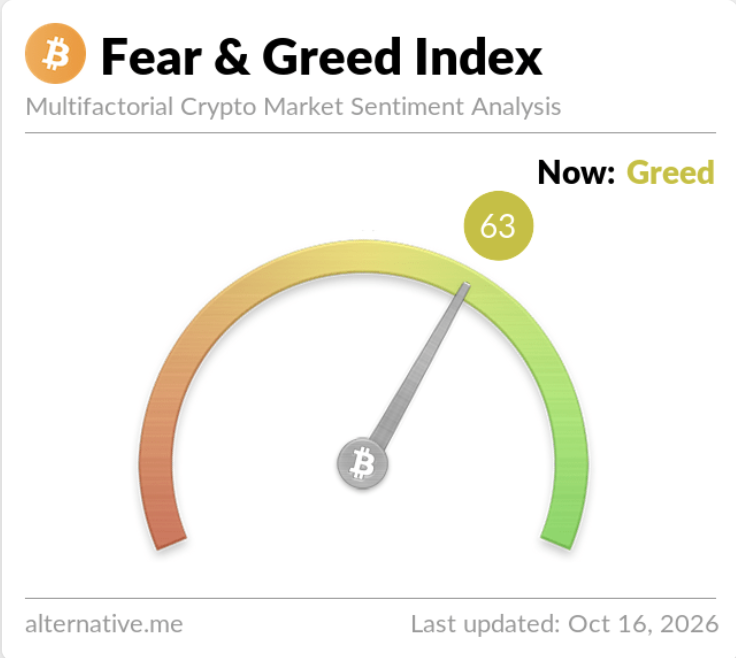
On October 16th, the Crypto Fear & Greed Index showed the market is currently in “Greed” with a score of 63 out of 100. While the indicator provides context for the market, it doesn’t establish if the bear market has ended. Instead, it shows how much investors are willing to risk given their risk-on appetite.
Why do traders call it a bear market?
Traders refer to the period as a bear market because it's similar to how a bear attacks, swiping its paw in a downward motion. Similarly, the price of Bitcoin and other assets is experiencing swift declines as prices slide every day.
Contrary to what would be intuitive, bear markets don't mean a period when investors are inert and fail to take action. As mentioned above, it refers to how prices move in the market rather than how investors behave in the period of uncertainty when prices are sliding lower, and there's no incentive to invest.
When was the last bear market in crypto?
The last bear market in crypto started in 2022 after the market peaked in 2021 at $67,617 and then dropped to $15,742 in November 2022. The drawdown was triggered by a black swan event, which refers to a perception-altering event, such as the Terra/LUNA ecosystem collapse in May 2022.
As in every situation, bear markets follow periods of euphoria when the market feels invincible. Following the LUNA event, other companies like FTX declared bankruptcy, which led to a lot of liquidity being taken out of the market. Data collected by CoinGecko notes the bear market lasted 381 days, with Bitcoin prices dropping by 76.7% in a year.
How bad was each bear market cycle?
Each crypto bear market has had a different duration and depth, but the structural ones have consistently wiped out 75% or more of Bitcoin's value. Using CoinMetrics data, the table below shows Bitcoin's major bear cycles, using data that defines a bear market as any period where Bitcoin closes below its 200-day moving average for 30 or more consecutive days.
Among these selected episodes, the biggest drawdowns occurred between 2014-2015: 84.5% and - 83.8% in 2018–2019. The 2025–2026 episode lasted 289 days below the moving average and reached a maximum drawdown of approximately 53.1%.
The COVID row needs to be analyzed in a separate context: Its 74.7% drawdown is measured against Bitcoin’s 2017 record daily close. It does not mean Bitcoin lost 74.7% within the 52-day episode. Likewise, an episode ending means Bitcoin regained the moving average, not that it recovered its previous record price.
The 2022–2023 bear market came close, with a 76.7% drawdown that wiped Bitcoin from its all-time high of ~$69,000 down to $15,758 by November 9, 2022, a 381-day grind that destroyed more dollar value than any prior cycle.
The selected Bitcoin episodes in this table lasted between 52 and 384 days below the moving average. The current 2025–2026 cycle has so far seen a -53.2% drawdown, with Bitcoin hitting a cycle low of $58,525.
Was Bitcoin’s June low the final bear-market bottom?
A June low is not automatically the final bottom. In 2022, Bitcoin recovered after its June sell-off but fell further during the FTX crisis in November. According to CoinGecko data, the later low occurred in November, not December, so describing that cycle as a predictable “June bottom versus December final low” pattern is misleading.
For the 2025–2026 episode, the daily price series used in our historical table records its lowest close at approximately $58,525 on 30 June 2026. That remained the lowest daily close based on our data points; however, “lowest so far” does not establish that a future decline cannot take Bitcoin lower.
What’s worth understanding is that sustained higher lows and a recovery above the 200-day moving average can strengthen the case for improving conditions. But it does not guarantee that the downturn is over.
How do bear markets in crypto differ from traditional finance?
A bear market in crypto is more severe than in traditional finance because crypto markets are more volatile and experience sharper drops even when correcting. One of the reasons is that stock markets have circuit breakers, which halt trading during periods of volatility to prevent complete wipeouts.
Recovery times vary considerably between downturns. Our analysis shows that the S&P 500 regained its pre-pandemic closing high on 18 August 2020, roughly six months after its February peak. There is no reliable rule for Bitcoin, but previous bear cycles lasted between 12 and 24 months to recover from the lows. Bitcoin recovers within 12–24 months, or crypto consistently recovers faster than equities. For reference, the S&P 500 recovered from the dot-com bubble in 13 years.
Crypto markets are heavily leveraged, so falling prices trigger cascading liquidations that accelerate declines. This also means that emotional trading plays a role in how traders behave, even though large-volume trades are mainly automated.
In sum, crypto markets have bigger downs more often but recover much faster. The S&P 500, as a point of reference, has had price corrections higher than 10% only 38 times since 1950 and recovered much more slowly than the crypto market.
How to identify a bear market in crypto
Bear markets are identified by drops from highs of more than 20% over a longer period of time, lower interest in crypto investments, and low on-chain activity. When looking at technical indicators on longer time frames, in bear markets, Bitcoin is trading below the 200-day moving average; in the current cycle, it is trading 230 days below it.
Another technical indicator that shows up in a bear market is the RSI, which shows the market is heavily oversold. This means any negative news on the market has a much stronger negative effect on the price. Investors and institutions are liquidating their positions to acquire Bitcoin much cheaper.
Accumulation phases on longer time frames of one year are signs crypto is in a bear market, as external shocks often confirm or intensify the trend.
Is the crypto bear market over?
A price rebound of 15-20% does not automatically mean a bear market is over. Any rebound has to be interpreted in the broader market condition: is the entire market recovering, what does TA show, is there more volume, is retail back?
For the crypto bear market to be over, there needs to be a strong sustained recovery rather than just a few positive sessions. This means:
- Successive higher highs and higher lows on a larger time frame
- Strength and consistency above the 200-day moving average
- Increased participation in the market, not just by institutions.
Does a bear market last longer than a bull market?
Bear and bull markets operate differently, and since 2011, bear markets have been significantly shorter than bull markets. Bear cycles can last between 1 to 2 years, depending on the duration and the length, while bull markets last more than two years. This, however, is conditional and depends on how traders perceive the time the bull market has started.
Bitcoin's two longest bear cycles between 2018–2019 (385 days) and 2022–2023 (381 days) lasted close to a year. Traditional markets show the same pattern: the average S&P 500 bear market runs about 9.6 months, while the average bull market lasts roughly 2.7 years.
How to adapt your strategy to a crypto bear market
Managing a crypto downturn starts with controlling exposure and understanding potential losses. It’s by no means about following a strategy and assuming it will preserve capital. Markets tend to trend downwards, and continuing to contribute to a token in the hope of recovering can backfire.
Dollar-cost averaging spreads purchases across regular intervals and can reduce reliance on a single entry price; however, this doesn’t guarantee someone will be profitable in the short or the long term. If the asset continues to fall, investors end up hemorrhaging capital, with hopes. Diversification and position limits can reduce concentration, but several cryptocurrencies may decline together.
Even stablecoins can introduce risks rather than eliminating them since depegging can occur when markets are volatile, and issuers need to reassess their risks. Lending platforms and yield products can expose investors to defaults. This shows that whenever a bear market is unraveling, and there is a black swan event, all crypto products can suffer losses at the same time. This would lead to withdrawal restrictions and technical failures.
Can you still make money and trade in a bear market?
Yes, you can still make money in a bear market, but it requires different strategies than buying dips in a bull run. Volatility stays high during downturns, which creates opportunities for prepared traders.
Several approaches can work when applied with strict risk management:
- Short selling: Borrowing and selling an asset to buy it back lower. This profits directly from declines but carries unlimited theoretical risk, so stop-losses are essential.
- Put options and inverse products: These rise in value as prices fall, with the downside capped at your invested capital.
- Range trading: Buying near support and selling near resistance works well when prices move sideways.
- Strategic accumulation: Building positions in quality assets at depressed prices to position for the next bull cycle.
The bottom line for investors
As of 15 October 2026, Bitcoin had recovered above its 200-day moving average but remained approximately 34% below its highest daily close. That supports a more nuanced assessment than simply calling the market bearish or bullish. Historical recoveries provide context, not a promise that Bitcoin will regain its price. Always understand that crypto and investing come with risks.
Frequently asked questions
Can you protect capital during a bear market in crypto?
Yes, investors can protect capital by diversifying their portfolio, holding stablecoins, investing carefully, generating yield, and dollar-cost averaging (DCA). Moving part of your holdings into stablecoins to prevent further losses also generates opportunities for earning without trading.
Is a bear market or a bull market better?
Bull markets are better for growing portfolio value quickly, while bear markets offer the most attractive entry points for long-term investors.
How do you know the bear market will continue?
You can't know for certain, but several signals suggest a bear market is ongoing rather than ending, which include the Bitcoin fear and greed index, more negative news, and low on-chain activity.
How are investors behaving during a bear market?
In bear markets, investors panic-sell as losses mount and negative headlines spread, while long-term holders and some institutions accumulate quality assets at lower prices.
Yieldfund is a quant-trading company where investors can access yields based on their chosen plan, without having to trade themselves manually. Always review the investment structure and terms, and discuss any additional questions with one of our dedicated account managers.
About the authors

Written by
Vlad Hategan
SEO content writer
Writes the articles in the Yieldfund knowledge base.
Dutch, English, Romanian

Translated by
Patricia Van den Kerckhove
Senior content translator
Translates and reviews Yieldfund's content in Dutch.
Dutch (NL & BE), French, English