

You do not need a large salary to diversify, but you do need the right order of operations. First, protect essential expenses with a cash buffer and tackle high-interest debt. Then use small, regular contributions to a broad, low-cost fund or ETF, adding other asset classes only when they match your time horizon and tolerance for loss.
In this guide, we show how to compare minimums and fees, build a simple diversified portfolio with little money, and avoid mistaking a long list of holdings—especially crypto tokens—for real diversification.
Why diversify your investments
Diversifying helps investors, even on a low budget or allocation, reduce the risk of having all their assets in one basket. When investments underperform, having multiple allocations means the rest of your portfolio can still perform well. Low-income investors can find value, as it safeguards limited capital while also providing growth opportunities.
Diversification spreads exposure across investments that may react differently to the same event. It can reduce the damage caused by one holding, company, or sector, but it cannot prevent losses in a broad market decline or make returns predictable. Diversification is a risk-management tool—not a return multiplier.
Before investing: build a cash buffer and pay off high-interest debt
When on a lower income, stringent financial events can affect your overall portfolio. Before considering investing, financial specialists say the priority is to build a cash buffer that covers emergencies. A cash buffer fits into your economic decision when you are laid off from work, unable to work, or unexpected expenses appear.
A second necessary step before looking even to diversify is to pay high-interest debt since that impacts the total amount you take home every month. Credit cards and bank loans have interest of up to 25% and in some cases even 40%, which means for a loan of just €1,000, you are paying up to €400 a month in some cases. Put into perspective, on a low income of €2,000, that’s a 20% cut.
What is investment diversification?
Diversifying income means finding new ways to allocate capital towards other financial investments to grow your portfolio.
We've seen that investors who start early, regardless of budget, are more likely to grow their investment over time than those who start later. It helps singles, families, and couples build financial resilience. When one part of their investment falters, others continue to generate cash flow and returns.
Importance of diversifying your portfolio to amplify your wealth
Diversification amplifies income by leveraging different asset classes with varying risk-return profiles. High-growth investments, such as stocks or crypto, can deliver substantial returns, while stable assets, such as bonds, provide consistent income. Together, they create a balanced approach that maximizes returns while managing risk.
This strategy is particularly effective for low-income earners because it allows small contributions to work harder. By spreading investments across multiple opportunities and investing early, users increase the likelihood that at least some will outperform, driving overall portfolio growth.
Why should low-income earners diversify their portfolios?
Low-income investors are often hesitant to invest and diversify their portfolios because they have a low risk tolerance, limited available capital, and longer recovery times from potential losses. Additionally, when income is limited, investing can be stressful and involve emotional decisions.
Assume a €500 portfolio is split equally across five holdings. Each holding is worth €100. If one falls 30% while the other four are unchanged, the portfolio loses €30, or 6%. If all five fall together, diversification does not protect the portfolio. The example illustrates concentration risk; it is not a forecast.
People with lower incomes and fewer investment options also benefit psychologically. Watching a single investment fluctuate can create added stress. With a diversified portfolio, a drop in one stock can be offset by an increase in another.
Should you diversify or not if you have a low income
The answer is straightforward: yes. Diversification is more critical for low-income investors than for wealthy ones. High-net-worth individuals can absorb losses more easily; low-income earners cannot afford significant setbacks that delay wealth-building goals.
Some argue that concentrating investments in a single high-performer generates better results. While theoretically true, this approach requires precise market timing and substantial risk tolerance. For most low-income investors, the risk outweighs the potential reward. Diversification provides a more reliable path to steady, sustainable growth.
How to Build a Diversified Income Portfolio
The objective when building a diversified income portfolio is the same whether you have a high or a low budget: to generate dividends, interest, or other distributions. Low-income investors can start small, with recurring contributions when cash reserves and expensive debt have been covered.
The first step is always determining what the goal is:
- Generate income
- Accumulate assets
- Combine assets
- Reduce dependence on a single investment
Investors should always choose safe investments, preserve their capital, and help it compound over time with minimal risk.
| Investment type | How it generates income | Volatility | Liquiditiy | Risks |
|---|---|---|---|---|
| Dividend equity fund | Dividends paid | Medium to high | High | Share prices can fall |
| Government Bonds | Interest from governments | Low | High | Interest-rate and inflation |
| Money funds | Interest from short-term instruments | Lower | High | Returns can decline when interest rates fall |
| ETFs | Asset apperciation | Medium to high | High | Recession, bad perfomance |
| Crypto or Yield | Staking or variable payments | Very high | Varies | Market, platform, counterparty risk |
After determining what means you use to diversify, several funds holding the same companies or bonds may create the appearance of diversification, so always do your own research.
The next step is to determine how much of the portfolio is assigned to different asset classes. On a lower budget, the split differs than when you have more capital to deploy, but it all comes down to the end goals. Short or long term?
Strong portfolios are built with recurring contributions, not one-off lump sum deposits. An investor might contribute a fixed amount each month and direct the money toward whichever part of the portfolio is below its intended allocation.
Finally, market movements can cause one investment category to become larger or smaller; periodic rebalancing restores the portfolio’s target allocation.
Thus, low-budget investors may be able to rebalance by directing new contributions toward underrepresented assets rather than selling existing investments. This can reduce transaction costs and may avoid creating an unnecessary taxable sale.
Ways to diversify your portfolio with a low budget
Start with low-cost index funds and ETFs
ETFs are investment vehicles that offer instant diversification at low cost. People can enter through brokers with as little as €5 and gain exposure to a larger pool of companies across multiple industries. ETF funds are a good entry point for long-term growth.
Compare the full cost of investing
Micro-investing apps like Revolut and DEGIRO have lower capital requirements, allowing investments as low as $10. They also offer automation tools to invest spare change from everyday purchases, making it easy to diversify without unnecessary complexity. These apps help ensure effective asset allocation, even on a small budget.
Use fractional shares when they improve access
Fractional shares let you buy less than one full share, which can make higher-priced stocks or ETFs accessible with less cash. Availability, eligible securities, execution, fees, voting rights, and transferability vary by broker. Fractional access lowers the cash needed for one security; it does not diversify a portfolio by itself.
Automate small contributions with dollar-cost averaging
We discussed DCA in a previous blog, but it's an extremely important aspect. Real diversification happens both across asset classes and within them. Several funds can also hold the same securities, so check their top holdings before assuming that more fund names mean more diversification.
A simple diversified portfolio example for a small budget
| Simple Setup | What It Contains | Why It Suis A Small Budget | What To Check Before Buying |
|---|---|---|---|
| One-fund core | One broad multi-asset fund or ETF holding stocks and bonds | A single recurring purchase and less moving parts | Country sectors and costs |
| Two-fund core | One big global stock or ETFs + one broad investment (local) | Have more control over risk mix while remaining simple | Total fees, taxes and overlapping holdings |
| Cash + Core | Emergency cash + either |
The right mix depends on when you need the money and how much loss you can tolerate. A larger fund can diversify within an asset class, but there is no guarantee a profit will be generated.
How to choose tools for a diversified income portfolio
The top tools for diversified income portfolios are portfolio trackers, quality brokers, and robo-advisors, and they are available to investors on a budget, as most are free to use.
The most suitable tools depend on whether someone wants help with their investments or is comfortable diversifying without assistance. These also include tools to automate recurring contributions or delegate asset allocation and rebalancing.
An investor may use more than one tool. For example, a fund screener can help identify broadly diversified ETFs, a broker can execute the purchases, and a portfolio tracker can monitor the resulting allocation.
Product availability also matters. A platform with low trading fees may not offer the funds needed to create the intended allocation. Conversely, a platform with thousands of investments may create unnecessary complexity for someone who only needs one or two broadly diversified funds.
Top tools for diversified income portfolios
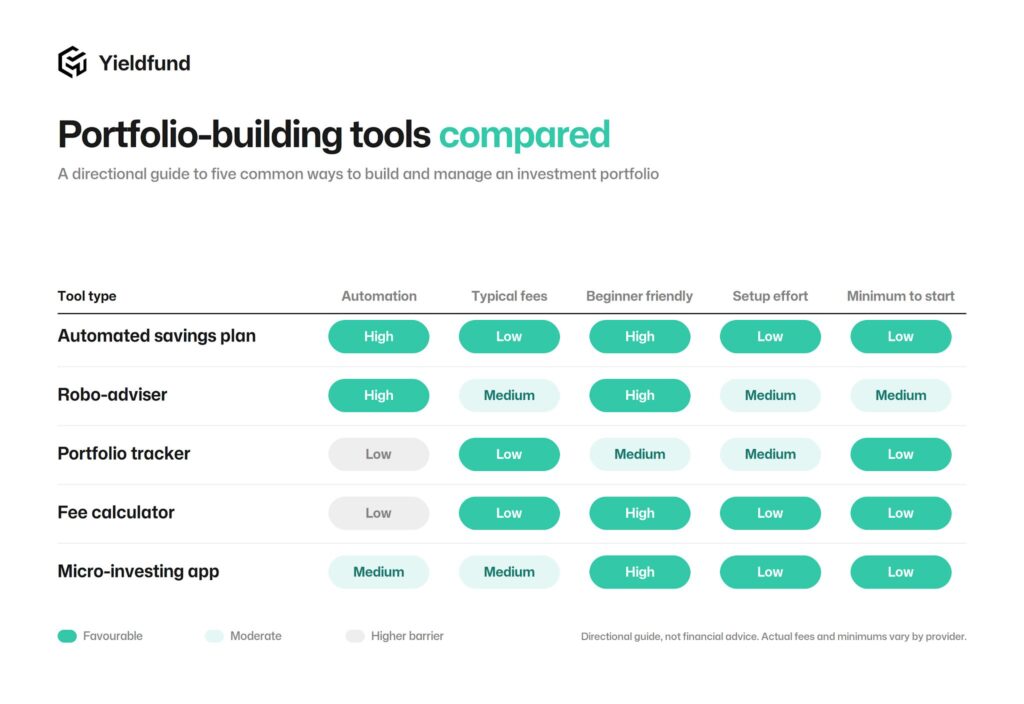
Avoid letting tools create unnecessary complexity
Using more platforms and investment products does not necessarily improve diversification. Several accounts can make fees, taxes, allocation and performance harder to monitor.
A low-budget investor may benefit from a simple arrangement:
- One regulated platform that offers the required products
- One or two broadly diversified investments
- An affordable recurring contribution
- A basic method for monitoring the target allocation
- A periodic review of fees and fund overlap
Any tools you choose to use should support the investment plan rather than determine it.
Smart alternatives to investing for a low income
Education and skill development can dramatically increase earning potential, providing more capital for future investments. Consider online courses, certifications, or training programs that enhance career prospects. The return on education often exceeds traditional investment returns.
How and when to rebalance
Diversifying on a low income should be especially beneficial for investors with limited market knowledge and who tend to be emotional. Modern tools and accessible platforms make it easier to invest and forget. It's always better to start investing early with a low budget than late.
If you have more capital to invest and want to diversify further, Yieldfund, a quantitative trading company, offers yearly returns and weekly payouts in stablecoins.
FAQ
How can low-income households diversify their income streams in the Netherlands?
In the Netherlands, household can diversify their income by investing, participating in the gig economy by providing certain services, and also exploring supported entrepreneurship programs.
Explore options for micro-investing with minimal capital
Micro-investing platforms like Trade Republic, DEGIRO, and eToro serve European investors with low or no minimum deposits. These platforms offer fractional shares, automated investing, and diversified ETF portfolios.
About the authors

Written by
Vlad Hategan
SEO content writer
Writes the articles in the Yieldfund knowledge base.
Dutch, English, Romanian

Translated by
Patricia Van den Kerckhove
Senior content translator
Translates and reviews Yieldfund's content in Dutch.
Dutch (NL & BE), French, English