

Investing in the Netherlands is more accessible than many think and requires only some basic knowledge. The difference between different types of risks is the type of investment you’re making and how informed you are about the risks. For Dutch people who hold cash in 2026, there are multiple opportunities to put the money to work, and this article covers the 8 ways to invest if you live in the Netherlands.
Why invest in the Netherlands
In the Netherlands, the local economy provides a combination of economic stability and advanced financial infrastructures. With one of the highest average living wages in the EU, people in the Netherlands have more opportunities to seek ways to increase their wealth as 2026 data shows that Dutch household portfolios increased to €204.3 billion in 2026 - according to DNB data from February 2026.
With new changes expected to come into effect in 2028, which could affect capital gains and even savings, it becomes ever so important to begin early. But where to start?
While most of the information online can be daunting for everyday people and becomes scarier as they dive deeper, people should consider investing early rather than never.
What to look for when you get started
When you start thinking about investing in the Netherlands, several key elements come into play: taxes, diversification, capital, and most importantly, the risks associated with investing. The Dutch Authority for the Financial Markets (AFM) is the government body that oversees the operations of financial companies in the Netherlands. One thing they always advise is to understand the product.
If you want to invest in Holland, choosing the right platform is essential. It should be a platform regulated in the Netherlands, as this decreases the risks of fraud and could have higher security compared to non regulated platforms.
Secondly, understand how taxes are paid: residents pay tax on investment income in Box 3. In 2026, Dutch residents have a €59,357 tax credit per individual or €118,714 if they are registered fiscal partners.
Finally, this article will cover the types of investment products along with their risks. No investment is 100% safe. The best approach for new investors is to analyze, read, and inform themselves before committing any capital.
How to start investing in the Netherlands
To invest in the Netherlands you need to come prepared. That means having a plan, understanding the risks, knowing what you sign up for and finally studying every option. Here are the six steps to take before investing in Holland.
- Create a plan. Tell yourself what you are investing for. Is it a new car, is it to build wealth, have a retirement account or have money set aside.
- Set your budget. Before you start, know how much you can take from your take home pay and put aside. Investing too much makes day to day living difficult. Setting too little won’t make a big difference.
- Know when you need money. This part is where many people get it wrong. Investments often means capital is locked away, for various periods of time. Establish how urgent capital is to know how to invest.
- Choose how much support you need. With a self-directed account, you select investments yourself. A managed service makes investment decisions within an agreed mandate.
- Compare investment types. Look at the risk and returns of each investment type. Always consider fees, lock up times and even volatility before making a decision.
- Start investing. This is the most obvious one, but requires an account verification. Always make sure you keep passwords safe to secure your investments.
8 Ways to invest your money in the Netherlands
In the guide on how to invest in the Netherlands, we analyzed the most common types of investments available to regular people. When we scored each investment type, we analyzed the risk/reward ratio, complexity, how accessible it is for regular people, how volatile or risky it is and what the potential returns are.
Here is our breakdown of the primary ways you can invest in the Dutch market in 2026.
Savings Accounts (Banks)
Savings accounts remain the easiest way for people to invest their money. Interest on savings accounts range between 1.5% to 3% (in the best cases) they can barely beat inflation, which in the Netherlands in 2026 reached 3.4% according to official data. Even with lower interest rates provided by banks, savings accounts are the easiest form of investment for everyday people.
In the Netherlands, bank deposits for individual accounts are covered up to €100,000 under the Deposit Guarantee Scheme (DGS). Neobanks like Bunq or Revolut can often offer more competitive rates than traditional giants like ING or Rabobank.
Investment Score: 2/5
Banks offer high security, so bank deposits are protected up to €100,000
Investment Funds (Mutual Funds / ETFs)
ETFs are a way for people to invest in a broad group of stocks (such as tech) without having to follow them individually.
Funds have become more appealing to investors, yet they are more difficult to understand compared to savings accounts for non financial people. While the buying process is simple, investors need to look for regulated platforms and understand which ETFs to buy. For reference, two of the most important indices are:
- Globally: The S&P 500 which tracks the top 500 US listed companies.
- The Netherlands:The AEX, which tracks the top 30 Dutch companies.
These funds are more complex and somewhat riskier than savings, but they can provide higher returns by tracking industries that perform well, though this only applies in certain cases.
Investment Score: 3.5/5
The balance of risk and reward is effective, liquidity is high, and interest can compound passively.
Stocks (Direct equity investing)
Stocks are shares of a company, and buying them allows anyone to own a share of a company that has gone public. One example is buying a share of Shell or Unilever stocks. These can be bought similarly to ETFs from a broker.
Compared to bigger pools of stocks, these have a higher risk profile in some cases. Why? Because any news, bad earnings can directly influence their performance. People can use regulated platforms like DEGIRO or neo banks like Revolut to buy stocks.
The upside is that investors can earn from both price appreciation and dividends, the share of profit paid out by companies to investors.
Investment Score: 4/5
Stocks require a higher level of research and understanding. If done right, they have a high potential for passive returns; however, they also carry a higher risk.
Real Estate
The Dutch housing market has historically been a strong performer, driven by a chronic housing shortage. Investing in bricks-and-mortar can provide rental income and capital appreciation.
Starting in real estate is costly as it requires significant upfront capital, and in the Netherlands, the housing shortage can also create barriers. High fees and limits on the number of houses have put pressure on homeowners.
The most common way to enter the housing market is to own a house and use a mortgage. That is more of a personal financial plan than an investment strategy, as with stocks.
Investment Score: 2.5/5
It's a solid asset that has long-term value, but it's less liquid and less accessible to everyday investors. However, regulatory pressure on landlords is increasing.
Pension Investments (Pillar 2 & 3)
The Dutch pension system creates long-term investment opportunities, as beyond the AOW state pension, the "Third Pillar" involves private individual pension products.
People can invest in pension accounts, which become available only at retirement. There are also benefits to using this system, such as higher returns than banks, reduced taxable income in the current year, and tax-free capital growth.
The downside of it is the lack of liquidity. Money is locked in the savings accounts and can't be accessed in case of any emergency. Thus, it's only a long-term investment vehicle.
Investment Score: 3.5/5
Excellent for planning and security with above-average returns, but provides zero liquidity.
Government Bonds
Bonds are loans you make to the government in exchange for regular interest payments. Dutch State Loans (DSL) are considered extremely safe due to the country's strong credit rating.
Bonds are effectively money you are lending to the government, with a maturity of 1 year or, in some cases, more. The returns, however, are minimal with government bonds covering inflation, but compared to bank deposits, they could carry a lower risk.
Investment Score: 2.5/5
The goal is capital preservation with no taxable income on returns. No ideal for wealth building.
High Risk Investments (Crypto)
High-risk investments such as cryptocurrencies and alternative financial products are exactly what the name shows. They are a higher risk way of investing capital. Cryptocurrencies are known for providing higher-return but with far greater risk than any other investment tool.
Crypto has specifically outperformed most markets over the past 10 years, but the issue in 2026 is that it's less liquid and extremely risky to navigate. For new investors, the learning curve is much steeper and comes with greater volatility than in regular markets.
While high-risk investments are appealing, a portfolio can go from 100 to 0 within a day. They carry significant risk but offer high returns.
Investment Score: 3/5
Maximum yield potential. Requires strong risk management and emotional discipline.
Commodities
Commodities like gold and silver serve as stores of value. You can invest physically by buying coins or bars, or digitally through ETFs.
Gold is traditionally a hedge against inflation and economic uncertainty. When the stock market wobbles or currency values fluctuate, gold tends to hold its ground. However, commodities do not produce cash flow—they do not pay dividends or interest. Your profit depends entirely on price appreciation.
Investment Score: 3/5
Great for portfolio insurance, but not for income generation.
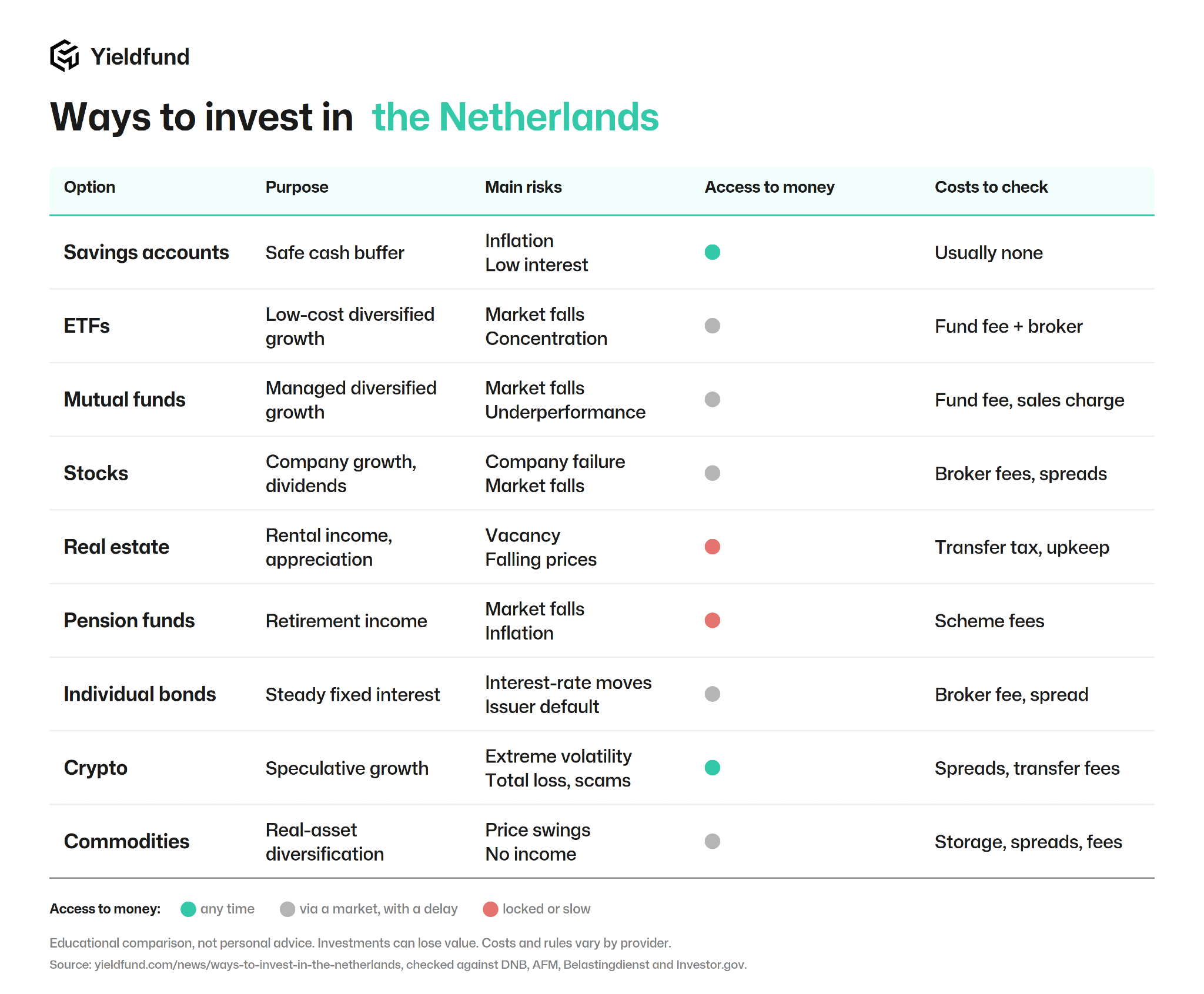
Which investment option in the Netherlands is best for your goals?
The best investment in the Netherlands depends on when you need the money, the losses you could afford and the costs involved. The AFM recommends assessing these factors before choosing a product.
Final words
Investing in the Netherlands in 2026 requires investors to shift their mindset from saving to actually focusing on wealth building. While there is no single "best" way to invest, people should choose based on their risk tolerance, knowledge, and goals. The days of relying solely on bank interest are behind us, as to really invest means exploring other opportunities to allocate capital and outpace inflation.
Yieldfund is a quantitative trading company, where investors can access crypto market yields without having to learn or trade themselves. Investors sign up for an investment plan, select between 1, 2 or 3 year plans and receive weekly payouts based on the plan’s structure.
About the authors

Written by
Vlad Hategan
SEO content writer
Writes the articles in the Yieldfund knowledge base.
Dutch, English, Romanian

Translated by
Patricia Van den Kerckhove
Senior content translator
Translates and reviews Yieldfund's content in Dutch.
Dutch (NL & BE), French, English