

- Passive income requires limited ongoing effort, but usually needs upfront time, money or both.
- Common passive income sources include savings interest, dividends, rental income and royalties.
- Building passive income starts with a realistic budget and understanding the costs, ongoing work and risks
Passive income is a way to earn money without trading time for it, with minimal ongoing effort. In 2026, it is no longer a niche way to earn, as data show people need an extra income stream.
People pursue passive income streams either to generate more income or to pursue financial freedom, and this article breaks down the realities, the drawbacks, and ways to apply them.
What is passive income?
Passive income is money that you earn from assets you own or from work that was done upfront, with minimum ongoing effort to generate that extra income. Think about how savings add returns to one’s accounts without doing any investing.
The term “passive income” means money comes in, but work was done beforehand, since passive income only works when someone invests money or time before the process begins. Calling income passive is an overstatement. Everyone who generates passively has to handle maintenance, administration, and occasional updates.
Passive income refers to reduced ongoing involvement rather than guaranteed returns.
To clarify, the examples below are the top sources of passive income in 2026 and will provide a clearer understanding of what passive income truly entails:
- Dividends earned from stock investments
- Rental income from property or other assets
- Earnings from selling digital products, such as e-books or courses
- Interest collected from bonds and savings accounts
How does passive income work
Passive income allows you to generate additional earnings by leveraging existing capital or resources with minimal ongoing effort. While it requires an initial investment of time and energy to establish, passive income can provide consistent returns over time with little day-to-day involvement. It is a key component of a well-rounded financial plan and can be achieved through various methods.
One common approach is to invest in stocks or ETFs, which can generate regular dividend income. However, this method carries some risk, especially for investors who take a passive or hands-off approach to managing their portfolios.
Real estate is another popular avenue for passive income, with property rentals yielding steady returns. However, this requires a significant upfront investment to purchase the property.
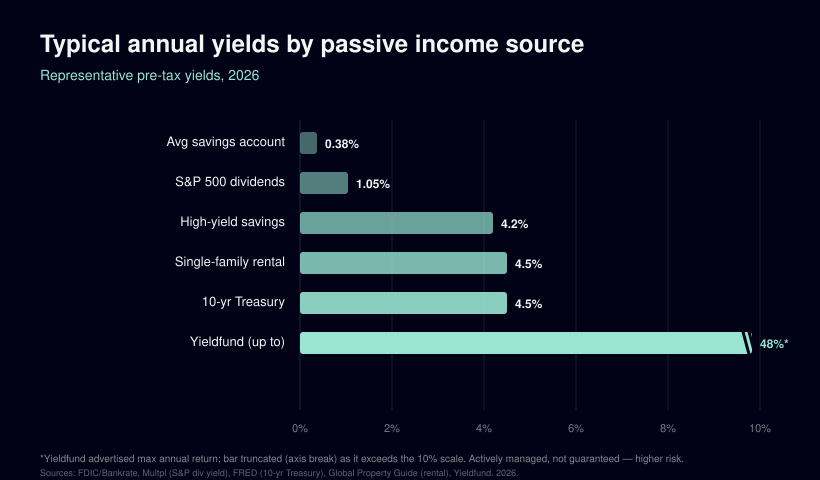
For context, in 2026, a regular savings account pays just 0.38% APY, which is below inflation. The S&P 500's dividend yield sat near 1.05%, while higher-yield routes like high-yield savings (~4.2%), 10-year Treasuries (~4.5%), and single-family rentals (~4.5%) require either locking up cash or taking on more risk.
What are examples of passive income?
Passive income examples include interest from savings or government bonds, as well as rental income, royalties, and alternative investments.
The difference between passive investment types is how much work and time they require and whether you have to do work upfront.
For example, dividends from savings require upfront capital. While work was done to gather the funds, there’s no additional time input required. The same applies to real estate and savings. A side hustle is an example of an extra income stream that still requires input.
How to create passive income
Passive income doesn’t come without investment, and to build it, anyone needs a foundation. Either it’s a skill that’s automated - and in 2026, that’s a real possibility- or there is idle capital that can be generated without effort.
Bank deposits are the main way someone generates passive income, and although small (below inflation numbers), they do generate capital. Generating passively is part of a new culture, and investors are following a different trajectory.
As we’ve discovered, people with existing capital seek to maximize their potential by investing to create more money. Some choose high-yield deposits; others buy property; others pursue structured investments. Even passive income comes with its own risks.
To create passive income, someone would need to:
- Know their financial possibilities.
- Understand where to allocate capital.
- Assess the risks and payments, including taxes.
- Allocate capital strategically to build over a longer period.
Reasons for building passive income
Building passive income sources is a smart strategy to implement, and it's more than just a "nice to have" way of using your money. It is a strategic element of financial stability, as it helps you diversify your finances and generate a small but steady profit.
- Diversified income streams: Passive income adds a layer of financial resilience by complementing your primary earnings.
- Financial freedom: Generate extra cash flow to reduce debt, save for retirement, or fund life goals like travel or education.
- Peace of mind: Knowing you have a stable, recurring income can help mitigate anxiety around employment or economic changes.
- Long-term wealth generation: Reinvesting passive income earnings can accelerate financial growth exponentially.
Which investments can generate passive income?
Investments that pay interest, dividends, or cash distributions generate income passively. However, you need to make an important distinction. Owning an investment does not automatically mean receiving regular payments or even being profitable
Common options include:
- Dividend-paying shares: Some companies distribute profits to shareholders. Dividends can be reduced, and a share's price can also fall.
- Interest-paying bonds: Governments or companies pay interest on money you lend them. Payments depend on the issuer’s ability to meet its obligations.
- Distributing ETFs and investment funds: These can pass investment income to investors. Check the share class: accumulating funds reinvest income rather than paying it out.
- Real estate investment: These offer exposure to income-producing property, but they require a higher upfront cost. Governmental policies influence how and whether the property increases in value. Also, income is generated only when the property is sold or when you collect rent.
Passive income means capitalizing on your resources, knowledge, and skills.
How can beginners start building passive income?
Start with an approach that fits your budget, skills, and available time. The goal is to build a manageable income source and not replace your salary.
- Protect your everyday finances. Keep an emergency fund easily accessible, and prioritize paying off high-interest debt before committing money to investments.
- Identify what you can contribute. Spare capital can generate interest or investment income. If you have limited money but useful skills, creating a digital product may be an option—although production and marketing require work.
- Understand how you will get paid. Check where the income comes from, when payments arrive, and what could interrupt them. Include fees, taxes, maintenance costs, and any restrictions on withdrawing your money.
- Start small. Set an affordable budget for money and time. Test the approach before committing more; choosing one investment approach does not mean putting everything into one company or asset.
- Review the actual results. Track income after costs and the hours needed to maintain it. For investments, also monitor changes in value: receiving payments does not necessarily mean making an overall profit.
Benefits of passive income
Passive income has its set of benefits and perks, especially when done correctly.
- Flexibility: Passive income streams can provide free time, allowing individuals to spend more time with family and pursue hobbies.
- Stability: Reducing reliance on a single source of income, especially during uncertain economic times, can provide a sense of long-term stability
- Scalability: Income streams aid in building other avenues that grow exponentially with minimal additional effort.
Disadvantages of passive income
While there are upsides to passive income, not every avenue is ideal, and some may have drawbacks.
- Upfront efforts: Building passive income requires significant time, sacrifice, and even expertise at the start.
- Unpredictability: Not all passive income streams yield consistent and reliable results, as market fluctuations or asset depreciation can impact returns.
- Initial Costs: Many opportunities, such as real estate or high-yield investments, require a substantial initial investment.
Secure a financial future through passive income
Passive income has become something every investor is looking towards. Whether it's higher income or lower maintenance, passive income helps investors build financial stability with minimal input. Regardless of what avenue you're looking to explore, the key is to start small, stay consistent, and watch your returns come in.
Yieldfund makes generating passive income simple, as it provides a low entry barrier compared to other structured investments or funds. To understand how Yieldfund fits into the passive income process, schedule an appointment with one of our relationship investment managers.
About the authors

Written by
Vlad Hategan
SEO content writer
Writes the articles in the Yieldfund knowledge base.
Dutch, English, Romanian

Translated by
Patricia Van den Kerckhove
Senior content translator
Translates and reviews Yieldfund's content in Dutch.
Dutch (NL & BE), French, English